Sufferah, p.1
Sufferah, page 1


CRITICAL PRAISE FOR ALEX WHEATLE’S NOVELS
“Alex Wheatle writes from a place of honesty and passion, with the full knowledge and understanding that change can only happen through words and actions.”
—Steve McQueen, Academy Award–winning film director
for Kemosha of the Caribbean
• A Junior Library Guild Gold Standard Selection
“A stunning historical adventure that upends stereotypes.”
—Times (UK)
“Kemosha’s indomitable spirit, determination, and wit make for an unforgettable heroine.”
—Guardian (UK)
“Inspired by accounts of women pirates, this fantastical tale represents the era’s cruelty without romanticizing it. Kemosha’s love and persistence combine with forceful action, the terror of harsh racism, and passionate, colorful language.”
—Toronto Star
“Kemosha’s heart and tenacity are endearing.”
—Kirkus Reviews
“Wheatle’s swashbuckling latest blends adventure, history, and poignancy … Well written and full of thrills, this cross between Margarita Engle’s Hurricane Dancers and L.A. Meyer’s Bloody Jack Adventures series will inspire hope and spark admiration.”
—Booklist
“Kemosha of the Caribbean is easily the best pirate tale I have ever encountered. If that seems a bold statement, its boldness pales in comparison to Kemosha’s enduring bravery and steadfastness.”
—The Plot Thickens
“Readers are in for a wild ride through this rich mix of cultures, lifestyles, [and] languages.”
—Children’s Literature
for Cane Warriorsr
“Alex Wheatle departs from his award-winning contemporary novels for a superb foray into historical fiction … Wheatle’s characteristic kennings and coinages … heighten this intense, affecting story of courage, bloodshed, and commitment to freedom at all costs.”
—Guardian (UK)
“I read it in one sitting. I simply could not put it down. Cane Warriors is such a powerful narrative of trauma and triumph … Wheatle celebrates the heroism that Tacky inspires. He tells the riveting story of fourteen-year-old Moa who bravely joins Tacky’s army.”
—Gleaner (Jamaica)
“Wheatle brings the struggle of slavery in the Jamaican sugarcane fields to life … A refreshing and heartbreaking story that depicts both a real-life uprising against oppression and the innate desire to be free. Highly recommended.”
—School Library Journal, starred review
for Home Girl
“Another powerful and poignant novel deftly created by one of the most prolific master novelists on either side of the pond. Home Girl is a page-turner, with not a dull moment. Loved it from the rooter to the tooter.”
—Eric Jerome Dickey, author of Before We Were Wicked
“Teenager Naomi, old before her time and as vulnerable as she is fierce, is growing up in the care system. Foster homes and pupil referral units reveal the unsettling, often bewildering reality of this existence. Wheatle’s empathy, authentic characters, and rich dialogue illuminate the dark.”
—Observer Magazine (UK)
“Naomi Brisset is a teenage girl growing up too fast in the UK care system. Her journey through a series of foster homes exposes the unsettling, often heartwrenching truth of this life. Yet despite the grit, Wheatle’s writing is as rich and warm as ever, bringing courage and hope to an unforgettable heroine’s story.”
—Bookseller (UK), Editors’ Choice
“With a tough exterior and brash attitude, Naomi is an authentic character in an unfortunate yet accurate picture of modern-day foster care in the UK … The ending is neither predictable nor sugarcoated, leaving readers rooting for this determined heroine.”
—School Library Journal
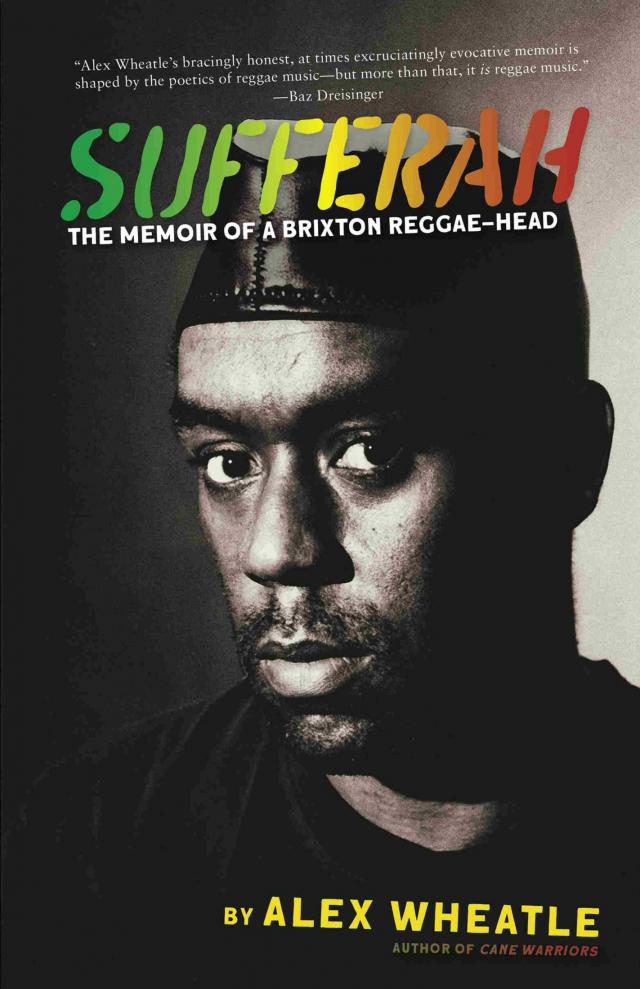
SUFFERAH
THE MEMOIR OF A BRIXTON REGGAE-HEAD
BY ALEX WHEATLE
All rights reserved. No part of this book may be reproduced, stored in a retrieval system, or transmitted in any form, by any means, including mechanical, electronic, photocopying, recording, or otherwise, without the prior written consent of the publisher.
Published by Akashic Books
©2023 Alex Wheatle
ISBN: 978-1-63614-093-3
E-ISBN: 978-1-63614-094-0
Library of Congress Control Number: 2022947076
All rights reserved
First printing
Photos courtesy of Alex Wheatle
Akashic Books
Brooklyn, New York
Instagram, Twitter, Facebook: AkashicBooks
E-mail: info@akashicbooks.com
Website: www.akashicbooks.com
To the sufferahs in my world who didn’t quite make it.
They went to their reward far too young.
Peter Davis
Dorothy Wynter
Sarah Doyle
Clement Bailey
TABLE OF CONTENTS
Introduction by Vanessa Walters
Prologue
Part I: You Can’t Blame the Youth
An Unsuitable Birth
Reggae Awakening
Post-Curfew Skanking
Extracting Maximum Bass
Bowling Like Michael Holding
A Schoolboy Crush
Tony Parkes and His Legendary Afro
Gold Cup Dance
Church vs. Football
Expelled
Strictly Come Skanking
Pressure Dropping
A Hungry Man Is an Angry Man
Brixton Blues Night
Living on the Frontline
New Trainee
Unmerry Christmas
Reggae Temples
Crucial Rocker Forward
Finding Identity
Party Hunters
Exploitation
Part II: Babylon System Is the Vampire
New Cross Fire
Arrested Development
Live and Direct from Elm Park, Brixton Hill
Brixton Uprising
Aftermath
Babylon Strikes Back
At Your Majesty’s Pleasure
Prison School
Release
Seeds of My Creativity
Blind Date
Tracing My Roots
Part III: If Yuh Have a Paper, Yuh Must Have a Pen
My Own Home
Learning Responsibility
Digging Up the Past
Jamaican Radio and Dragon Stout
Pilgrimage to Jamaica
Final Destination
Corrugated Jungle
Dangerous Driving
Afterword: Working My Talent
Acknowledgments
INTRODUCTION
by Vanessa Walters
Wi liccle but wi tallawah. Small but mighty.
Bob Marley described Jamaica as “the university of the world,” and it is nearly impossible to overestimate the global impact of this small island of fewer than three million people. Jamaica has been a pivotal part of world history, from the arrival of Christopher Columbus in 1494, through the genocide and enslavement of the indigenous population and Africans who followed. The lessons of Jamaica’s history are humanity’s inheritance. Reggae music is part of its distinctive culture that encompasses the political and the existential, influencing protest movements, language evolution, and social transformation worldwide. Within its panoply of forms, the central message remains mental emancipation for the poor, the oppressed, the underestimated.
Sufferah, if they can but recognize their own innate power.
The sufferah takes center stage in many of Alex Wheatle’s stories. From Brenton Brown, the troubled mixed-race youth abandoned in the foster care system, to enslaved Kemosha, who becomes a swashbuckling pirate to liberate her people, Alex aptly illustrates the Jamaican proverb. The small but mighty hero or antihero takes on a hostile environment, often at a terrible personal cost, for a purpose bigger than themself.
Certain parallels might, I suppose, be drawn between the sufferah and standard-issue superheroes. Like Superman, the sufferah is disadvantaged from birth, sometimes lonely in their predicament, often on the outside looking in longingly, and just as Jor-El tasks his disheartened son with giving the same people who reject him “an ideal to strive toward,” the sufferah must also uplift humanity either within the pages or beyond. At least Superman gets to hide who he is behind the socially accepted disguise of Clark Kent. He finds acceptance and safety by cloaking his powers and knowledge with a nonthreatening persona. In contrast, the sufferah, by definition, is seen as antisocial, as unkempt or aggressive, mentally impaired—like the Rastafarians of Jamaica, the original persecuted sufferahs, were judged to be.
At first glance, Alex’s sufferahs might seem to challenge the reader to find any empathy for them. For instance, in East of Acre Lane, Biscuit is a Brixton drug dealer working for a sadistic gang leader. These sufferahs mostly don’t apologize for who they are either—if they even have self-awareness. They kick and scream their way onto the page. Yet we like them immediately, possibly recognizing the part of ourselves that resists conformity, or as one might root for a balloon tossed around in the wind, anxious about where it might end up.
Brenton Brown, Liccle Bit, Moa, Kemosha, Naomi, Biscuit—Alex has found many sufferahs for his award-winning novels. But now he takes us on a very personal sufferah journey: his own.
In the aftermath of slavery in Jamaica, Marcus Garvey is credited with initiating the Black consciousness movement that be came central to Jamaican culture. Despite being dismissed by the elite of his time, Garvey was revered by the lower classes as a prophet, giving rise to the Rastafarian movement. The movement rejected the colonial view of Black people as spiritually and physically inferior, instead centering Africa and Black people in conscious thought. Rastafarians survived repeated and often brutal attempts by the Jamaican government to destroy their movement. Eventually, they become known for their dreadlocks, antiestablishment stance, and a heightened sense of self, demonstrated by the unique use of the personal pronoun “I” and other words altered to fit their philosophy.
And then came the reggae: the thunder, lightning, “drum blood story,” electric storms, the rhythm of history setting the pace for violent uprising as explained in “Reggae Sounds,” a poem by the UK-based Jamaican dub poet and activist Linton Kwesi Johnson. Alex’s journey explores how reggae music sustained him through some of the most turbulent moments in his life and how these anthems provided context and companionship in his struggle. It was an unspoken language between others like him, offering a safe space free from hostility. Signposts that gave them a trajectory through the harsh winds of Great Britain. The Windrush immigration era (1948–1971) was sensationalized in Enoch Powell’s 1968 “Rivers of Blood” speech. A succession of laws were passed to restrict the flow of nonwhites to the United Kingdom. Ten years after Powell, Prime Minister Margaret Thatcher promoted fears that the UK “might be rather swamped by people with a different culture.” At the same time, she positioned the British character as morally superior and implied that xenophobia was justified.
Black people found themselves targeted by the racially applied stop-and-search “SUS” law, under attack from white nationalist groups, and obstructed in their search for employment and accommodation. The suffering was widespread. Films such as Harold Ové’s Pressure (1976) described a generation in crisis, and Babylon (1980) chronicled the rise of the reggae sound systems against the backdrop of endemic racism. Alex’s story is challenging reading at times yet never gets too dark, because we know that our sufferah has made it through. He also finds light even in the darkest of situations and shows us how far a little empathy can take us. How strong the human spirit is.
From Dickensian beginnings, Alex Wheatle has risen to be one of the most lauded writers in Great Britain and beyond, deservedly honored with an MBE for services to literature in 2008. His 2016 book Crongton Knights won the fiftieth Guardian Children’s Fiction Prize, while others have been translated into multiple languages and adapted for theater and television. Alex’s remarkable life story is the basis of the fourth film in Small Axe, Steve McQueen’s critically acclaimed anthology series about the Caribbean community in the UK during the 1970s and ’80s.
How on earth did he make it through? It’s a question that confronts us often as young Alec Alphonso Wheatle endures shocking abuse in the Shirley Oaks children’s home, and Wheatle the teenager runs riot (literally) through the streets of South London. We sit in the prison cell with him, smelling the stench of the shit bucket. We watch him flailing in his proverbial sea of troubles, wondering what fresh hell awaits him next.
But the clue is in the lyrics of the tunes he offers us. Rethinking oneself. The cornerstone instead of the castaway. Love instead of hate. Although riven by loneliness, he found joy and empathy among his reggae greats. These were friends and mentors—who understood what a young Black man was going through, who gave purpose to despair, whether plaintive commiseration or a mischievous croon. Pretty incredible to see every aspect of his life covered in the songs listed.
Whether real or imagined, Alex’s stories are a gift to us to never lose hope. His books are loved worldwide for their vivid, relatable characters and heart-pounding scenes. They were inspired by a boy in the UK who knew nothing about himself but found a rich heritage. If Jamaica is the university of the world, Alex Wheatle is its chancellor.
Vanessa Walters
Vanessa Walters, author of The Nigerwife, is a novelist, playwright, and journalist originally from London, now based in New York. She is of Jamaican heritage and has written extensively about the British-Caribbean experience. Her published work includes Smoke! Othello! and the young adult books Rude Girls and The Best Things in Life. Her plays have been staged across the UK.
PROLOGUE
HM Prison Wormwood Scrubs, June 1981
The stench of excrement filled my nose. Simeon, my Rastafarian cellmate, had me in a headlock. Tears streamed down my cheeks. I didn’t want to be alive. If there is a God, why is He mocking me?
I could never get used to the smell, so Dennis Brown sang in “Three Meals a Day.”
I gathered in a breath and let loose a primal scream. I tried to rid myself of all the pain, loss, injustice, and bitterness that I carried with me. Simeon placed a hand over my mouth. I tried to bite it. My body convulsed. I once again attempted to wriggle free from his firm hold.
“Calm down, my yout’,” Simeon pleaded. “Calm down. Why you try and kill me, eh? You t’ink me so easy to mash up?”
I was exhausted. Physically and mentally. I hyperventilated. Simeon released me. I sat myself against the wall and tried to control my breathing. Simeon looked at me hard. His eyes flicked toward the cell door. Maybe he considered informing the night warden of my mental state.
I’m talkin’ about detention, detention, Dennis’s voice echoed in my head. I’m talkin’ about detention.
Simeon took pity on me. He parked himself beside me and his intense gaze never left me alone.
“Someting eating you up, man,” he said. “Someting bad.”
I didn’t respond.
“Tell me your story, Alex,” he urged. “Every mon t’ink his burden is the heaviest, Bob Marley say. Unpack your burden.”
I stared into space, wiped the tears from my face, and turned to him. “No one’s ever gave a fuck about me,” I snapped. “From the day I was born!”
“Start from the beginning,” he said.
“I don’t know my beginning. I’m nothing. A nobody.”
“That’s how the people who are against you want you to feel.”
“It’s true,” I said. “I have nothing. I have nobody.”
“Everybody ah somebody,” Simeon smiled. “Yes, you have the fierce eyes of ah true-born sufferah. But you t’ink you’re the only one who experience nuff tribulation?”
I caught a hint of loss in Simeon’s eyes. Maybe some dark memory. He quickly recovered his composure.
“No,” I replied.
“Tell me your sufferah’s tale,” Simeon pressed. “The one ting we do have is time.”
I glared at the wall, wanting to headbutt it. I turned to him once more. “Okay,” I said.
I didn’t count the minutes and hours as I spilled out my life experiences to Simeon during that long night. He listened patiently, sometimes nodding, sometimes caressing his dreadlocks and closing his eyes in meditation.
“Rough inna Babylon,” he’d comment. “The devil walks among we. But so does good. Never forget that.”
PART I
YOU CAN’T BLAME THE YOUTH
Here I am in 1963 in the care of Miss Bibsy
AN UNSUITABLE BIRTH
I was born Alec Alphonso Wheatle in London on January 3, 1963, into a volatile situation.
My mother, Almira, who had arrived in the UK in the early 1960s without her husband and children, had a brief affair with my Jamaican-born father, Alfred. My mother’s husband came over to the UK on a surprise visit in the fall of 1962, only to find his wife pregnant. Almira worried about caring for me because I wasn’t her husband’s child. She had an impossible choice to make; she feared for my future if she chose to raise me.
Almira came to a decision. She entrusted me to Alfred when I was a few days old before returning to Jamaica where I had five older siblings. I only became aware that I had one brother and four sisters when I read my social services files nineteen years later. To this day, I haven’t received any explanation for why the authorities kept this information from me. If I had known, I might not have felt so desperately alone in my formative years.