Breaking twitter, p.1
Breaking Twitter, page 1


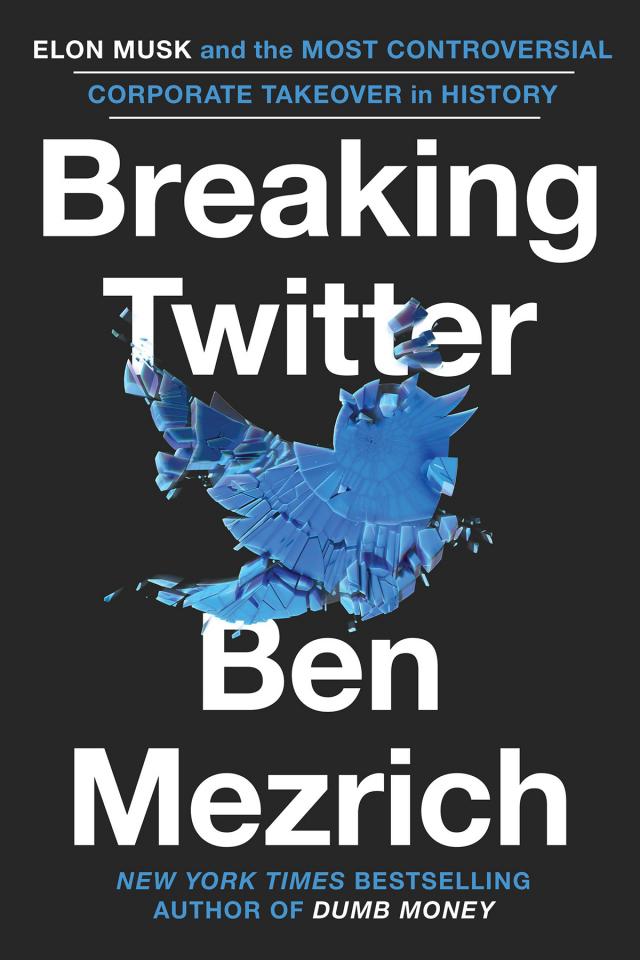
Copyright © 2023 by Mezco, Inc.
Cover design by Greg Mollica. Cover illustration by Danielle Del Plato.
Cover copyright © 2023 by Hachette Book Group, Inc.
Hachette Book Group supports the right to free expression and the value of copyright. The purpose of copyright is to encourage writers and artists to produce the creative works that enrich our culture.
The scanning, uploading, and distribution of this book without permission is a theft of the author’s intellectual property. If you would like permission to use material from the book (other than for review purposes), please contact permissions@hbgusa.com. Thank you for your support of the author’s rights.
Grand Central Publishing
Hachette Book Group
1290 Avenue of the Americas, New York, NY 10104
grandcentralpublishing.com
twitter.com/grandcentralpub
First Edition: November 2023
Grand Central Publishing is a division of Hachette Book Group, Inc. The Grand Central Publishing name and logo is a trademark of Hachette Book Group, Inc.
The publisher is not responsible for websites (or their content) that are not owned by the publisher.
The Hachette Speakers Bureau provides a wide range of authors for speaking events. To find out more, go to hachettespeakersbureau.com or email HachetteSpeakers@hbgusa.com.
Grand Central Publishing books may be purchased in bulk for business, educational, or promotional use. For information, please contact your local bookseller or the Hachette Book Group Special Markets Department at special.markets@hbgusa.com.
Library of Congress Cataloging-in-Publication Data has been applied for.
Interior book design by Timothy Shaner, NightandDayDesign.biz
ISBNs: 9781538707593 (hardcover), 9781538707623 (ebook)
E3-20230906-JV-NF-ORI
Contents
Cover
Title Page
Copyright
Dedication
A Note from Bestselling Author Ben Mezrich
Prologue: November 29, 2022
PART ONE Chapter One: More Than Two Years Earlier, January 15, 2020
Chapter Two: March 25, 2022
Chapter Three: April 4, 2022
Chapter Four
Chapter Five
Chapter Six: June 16, 2022
Chapter Seven: October 4, 2022
Chapter Eight
PART TWO Chapter Nine: October 26, 2022
Chapter Ten: October 27, 2022
Chapter Eleven
Chapter Twelve: October 28, 2022
Chapter Thirteen: October 31, 2022
Chapter Fourteen: November 3, 2022
Chapter Fifteen: November 9, 2022
Chapter Sixteen: November 16, 2022
Chapter Seventeen: November 21, 2022
Chapter Eighteen: December 11, 2022
PART THREE Chapter Nineteen: December 11, 2022
Chapter Twenty: December 12, 2022
Chapter Twenty-One: December 13, 2022
Chapter Twenty-Two: December 17, 2022
Chapter Twenty-Three: December 18, 2022
Chapter Twenty-Four: December 20, 2022
Chapter Twenty-Five: February 13, 2023
Chapter Twenty-Six: February 25, 2023
Epilogue: April 20, 2023
Acknowledgments
Discover More
About the Author
Also by Ben Mezrich
Notes
This is a work of creative, narrative nonfiction based on interviews and reporting done by the author. Some names and identifying details have been changed to protect the identity of certain parties, and some characters are composites reflecting characteristics of several individuals. Dialogue and some character perspectives have been reimagined, and the dates of some of the events have been adjusted or compressed to improve the narrative.
For Tonya, proof that this is all one wonderful simulation. I’m the luckiest NPC in the game.
Explore book giveaways, sneak peeks, deals, and more.
Tap here to learn more.
A Note from Bestselling Author Ben Mezrich
Breaking Twitter is a dramatic narrative account of one of the most unique and fascinating corporate takeovers in history, based on dozens of interviews, multiple first-person sources, and thousands of pages of documents. Though there are different and often contentious opinions about some of the events in the story, to the best of my ability, I re-created the scenes in the book based on the information I uncovered. Some dialogue has been reimagined, and the dates of some of the events have been adjusted or compressed. Also, at some points in the story I employ elements of satire. In some instances, composite characters have been created or descriptions and character names have been altered at the request of my sources to protect privacy.
This is not an authorized narrative of the events surrounding Elon Musk’s takeover of Twitter—as was his wont, Elon chose not to respond to requests for his participation. I can only imagine that this is not a version of the story Elon would be eager to see told: a narrative that isn’t just about the ends, but about the means used to get there, and the consequences of those actions. Scenes and comments from Elon’s perspective are triangulated from various inside sources, and are based on my own speculation as well as deep reporting.
I’ve been an avid Twitter user since November 2008. I’ve watched the site grow from a scrappy start-up to one of the most important social media sites online, with an outsized imprint on culture, journalism, and politics. When the news of Elon Musk’s interest in the site first broke—on Twitter, of course—I was instantly intrigued. To me, Elon is one of the most complex characters I’ve ever encountered: one of the richest men on Earth, the brilliant entrepreneur behind Tesla and SpaceX, and at the same time, the most outspoken “troll” on the internet, a man who seemed as comfortable baiting the Securities and Exchange Commission with humorous memes as he did running a trillion-dollar company.
Even so, I never could have predicted the wild, and sometimes absurd, dramatic turns that ensued as he set his sights on Twitter. From the serpentine road that led up to Elon’s takeover of the platform, to insiders’ accounts from within the San Francisco headquarters as the billionaire took control and began his chaotic first few weeks, to the much wider political and cultural implications of the privatization of our global town hall, Breaking Twitter is populated by outsized personalities with polarizing ideologies.
I believe it is one of the most important and thrilling stories I’ve ever told, the incredibly public, sometimes darkly comic battle between one of the most influential men of our time and the platform that sits at the center of our shared conversation.
PROLOGUE
November 29, 2022
Ten minutes past midnight on a Monday in late November, one of those crisp San Francisco evenings where the breeze sweeping up from the bay hit with the subtlety of a fist bristling with razor blades, Esther Crawford found herself in a dimly lit conference room, desperately trying to talk the richest man in the world out of starting the Silicon Valley equivalent of World War III.
It was just the two of them, alone and next to one another at a ridiculously long, rectangular table that sliced through the center of the tenth floor of Twitter’s main headquarters. Esther had her laptop open in front of her, the screen casting a cone of light across her porcelain skin. Elon Musk, hovering over her right shoulder, was in shadow, his wide, square face, impish eyes, and ever-present smirk barely lit by the fluorescent ceiling panels high above. Beyond the table stood a wall of glass that had once looked out onto the bustle of the rest of the floor, an open design that encourages a collaborative culture that the company had once been known for. After choosing the space as one of his preferred roosts, one of the first things Elon had done was to frost the glass—unintentionally transforming the once-lively room into a dark, cavelike bunker. During the day, the change was subtle, a muted glow from the office beyond; but at night, ominous shadows crept over the ergonomic furniture and lacquered wood fixtures.
Esther had been in the bunker since noon. Though colleagues had filed in and out during the day, she had been mostly on her own since sundown, when the view from the windows on the other side of the room had shifted from a vibrant cityscape of marble, glass, and steel, and the San Francisco State House offset by a pincushion of office buildings, to little more than a sea of flickering lights struggling against an ink-black sky.
She was hungry and tired, and hadn’t slept more than a few hours over the past forty-eight; she had just been contemplating heading home to her husband and three kids when Elon had wandered in, ten minutes before, flanked by his two hulking bodyguards, who were now positioned just outside the conference room door, like oversized gargoyles.
It wasn’t out of character for Elon to stop by the conference room without notice, even at odd hours of the evening. For weeks now, he’d been living in Twitter’s headquarters, sleeping on a couch in the library on the eighth floor until someone had carted a handful of beds up the service elevators for the billionaire and his team. Nor was it abnormal for him to meet one-on-one with Esther, even though she wasn’t officially upper management, and before the takeover she had been low enough on the chain of command that she’d have more likely found herself with the gargoyles on the other side of the frosted glass.
Her life had taken some dramatic turns in the past four weeks, since Elon had famously walked through Twitter’s front doors carrying a kitchen sink—“let that si
Tonight, it seemed, was going to be another one of those moments.
He’d burst into the room, crossing the conference area in three determined steps. The nearest chair to Esther had happened to be a miniature design piece that someone had wheeled over from a privacy alcove by the windows, and it took Elon an extra beat to stuff his boxy, six-foot-two frame into the confining apparatus. With arms and legs tucked awkwardly in front of him like a praying mantis, he’d launched right into it, continuing a conversation that had begun almost two days earlier. His tone had remained controlled, his volume low, but Esther had been able to tell from the start that he was already headed toward that cliff. If she didn’t act quickly, there was a real chance he was going to barrel right over the edge.
It didn’t help that the issue that had him so worked up at midnight on a Monday had begun as a simple misunderstanding. During the weeks she’d worked with the billionaire, she’d learned that at his core, he wasn’t driven by facts or expertise, but by instincts and intuition. Neither did it matter that in her heart, Esther actually agreed with Elon’s take on the situation, and shared his frustration: the system he had run up against was clearly unfair, and possibly even legally untenable.
But she was also certain that the decision Elon was heading toward, at breakneck speed, publicly declaring war on Apple, the world’s biggest tech company—and barely a month into his tenure at the helm of Twitter—would end in disaster.
To be fair, Elon wasn’t the first CEO to balk at Apple’s weighty fee structure, which took a 30 percent tithe on any in-app purchases made by customers; nor was he the first entrepreneur to have been under the illusion that he’d be able to work around this seemingly usurious fee by sending subscribers through a custom system of his own design. But when it had been made clear to him, in a meeting two days before in this very room—the long table sparsely attended by what remained of Twitter’s upper-level marketing and sales department—just how binding Apple’s payment structure was, Elon’s face had blanched, and his eyes had begun to blaze. Clearly, he didn’t see Apple’s fees as a simple, heavy-handed, profit-driven business strategy; to Elon, Apple’s behavior was a direct affront to his belief system of innovation, freedom, and competition.
At first, Esther had done her best to just listen to Elon’s concerns, acting as a sounding board. Maybe, despite his dismay at Apple’s policies, the rational portion of his brain would take over and he’d come to the conclusion that it was simply a noxious pill Twitter would have to continue to swallow. But very quickly, it had become clear that Elon wasn’t interested in accepting the status quo. By their third conversation on the subject, he’d told her that he intended to fight Apple, make it a legal battle, bring it all the way to the Supreme Court if necessary. Sensing that he was beginning to spiral, Esther had offered a potential solution; what they really wanted to do was divert Twitter’s paying customers to the web, and away from Apple’s platform—but Elon had immediately shut that idea down. The web, he had exclaimed, was an insecure place for payments; pushing paying subscribers toward the web would open Twitter up to bot attacks, a fear so antiquated that it had caught Esther by surprise. She’d tried, gently, to explain the safety of modern web payments. Esther herself had been on the team that had integrated Stripe as Twitter’s payment provider—to which Elon had icily replied, “I know more about payments than any of you.”
To better make the point, he’d demanded that Twitter immediately turn off all web subscription. Meaning, from that moment on, the only way anyone could make a payment to Twitter was via the app—primarily, via Apple. To Esther, this had been a bad business decision, stemming from paranoia. But she’d also realized that she herself had misstepped; rather than attempting to steer Elon away from that ephemeral edge, she’d confronted him—which had only sent him hurtling further forward.
There was a right way to handle Elon, and more important, a decidedly wrong way to handle Elon. And it wasn’t simply experience that had taught Esther this maxim; the day after she’d first met the billionaire, she’d been taken aside by a member of his entourage—the impressive young COO of his Boring Company, Jehn Balajadia, who in recent weeks had become Elon’s main operational liaison.
“You should know some things,” Jehn had told her, after sitting her down in a quiet corner of the headquarters. “Elon is a very special guy, and as someone who is going to be close to him, your job is to help take care of him, protect him, to make things go well for him. The world is going to want to get in through you, and you need to be really careful from now on.…”
In the previous few weeks, Esther had experimented with different ways to communicate with the billionaire, and had found that what worked best was a combination of humor and appeal to ego. What Elon seemed to love the most were memes, emailed to him at night (never in the morning), the edgier the better; what he feared most was anything that might damage his public reputation. For years, he had been known to most of the world as a genius, one of the greatest entrepreneurs in history. Since his takeover of Twitter, though, the conversation surrounding him had shifted in a decidedly negative direction, and he was extremely sensitive as to how people viewed him.
Over the past few days, as Elon had become more entrenched in seeing Twitter’s battle with Apple in ideological terms, Esther had attempted to use humor to placate the billionaire—sending him meme after meme poking fun at Apple, their fee structure, whatever she could think of that might defuse his growing vitriol. But just glancing at his Twitter account from the past twenty-four hours, she could see that her strategy was failing.
Calling Apple politically “biased” in a tweet to his one hundred million-plus followers, Elon had further expounded that “Apple has mostly stopped advertising on Twitter. Do they hate free speech in America?” He’d accused Apple of threatening to “withhold Twitter from its App Store.” Worse yet, at seven a.m. that very morning, he’d tweeted an image of a highway dominated by an exit sign offering two choices: “Pay 30%” accompanied by an arrow pointing straight ahead, and a left turn signal aiming toward “Go To War.” Though he’d since deleted the “Go To War” tweet, it was clear the idea had lodged itself in his mind.
Rocking slightly in the minuscule chair next to Esther, he was almost rambling now, deep in a monologue about Apple’s authoritarian behavior. How their in-app fees were a form of robbery, proof of their monopoly over the tech sector; how they needed to be broken up, fought legally. Then he began to go further, testing what she perceived to be another potential tweetstorm, setting off alarm bells within Esther that had her sitting straight up in her chair. He began talking about rallying his followers to go after Apple, not just online, but IRL, some sort of loosely defined protest at Apple’s headquarters. She could hardly believe she was hearing him right—he was essentially talking about sending people with pitchforks over to Cupertino.
Now she knew she had to act quickly. This path would not only have serious repercussions for Twitter’s future, but also wider implications that might destabilize the entire tech sector. A war between Twitter and Apple wasn’t an act of genius; it would be more akin to madness, and would surely tarnish the reputations of both companies.
She put her hands down on the table and rose out of her seat, all four foot eleven inches of her, now eye to eye with the mantislike entrepreneur. Then she laid it out in a way that Elon would understand. Twitter 1.0, as Elon had been calling the past regime, had left skeletons in Twitter’s closets that made a war with Apple unwinnable. So through no fault of his own, Apple had the billionaire by the balls.