

The splendid ticket, p.1
The Splendid Ticket, page 1


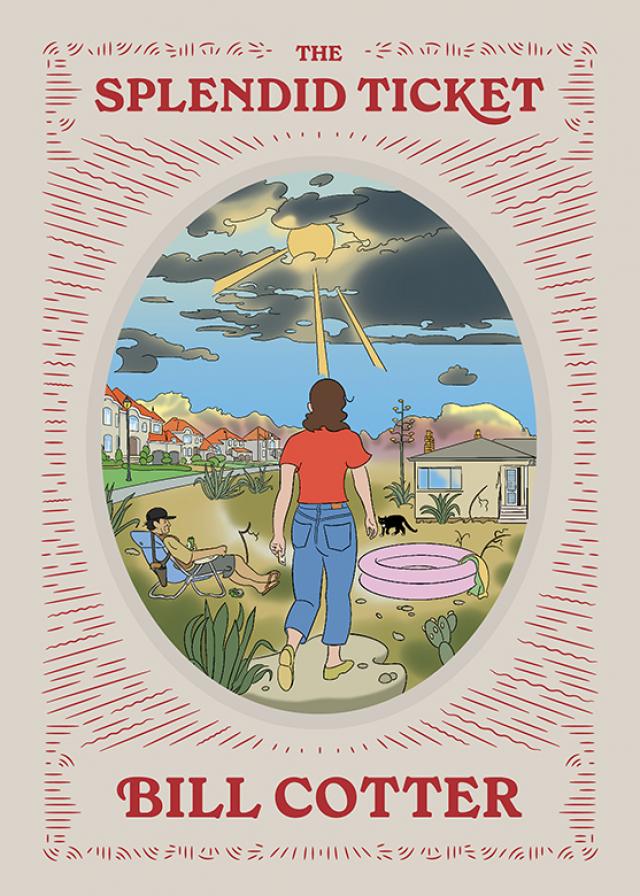
THE SPLENDID TICKET
Copyright © 2022 Bill Cotter
All rights reserved, including right of reproduction in whole or in part, in any form.
McSweeney’s and colophon are registered trademarks of McSweeney’s, an independent publisher based in San Francisco.
Cover illustration by Masha Krasnova-Shabaeva
ISBN 978-1-952119-50-7
10 9 8 7 6 5 4 3 2 1
www.mcsweeneys.net
THE
SPLENDID
TICKET
A NOVEL
BILL COTTER
For Krissy, the One.
CONTENTS
Part I
Chapter One: The Red Monster
Chapter Two: How we weep and laugh at one selfe-same thing
Chapter Three: The Vanishing
Chapter Four: Recoil
Chapter Five: Satellites
Chapter Six: A Sea of Chifforobes
Part II
Chapter Seven: Meringue
Chapter Eight: Gender Null
Chapter Nine: You Better Stop the Things That You Do
Chapter Ten: The Barrens
Part III
Chapter Eleven: The Palisade
Chapter Twelve: The Money
Chapter Thirteen: Venereae Sculptura
Chapter Fourteen: Breakfast in the Afternoon
Chapter Fifteen: Silver Sulfide
Chapter Sixteen: The Melted Crayons
Chapter Seventeen: SWIFT
Chapter Eighteen: Drag
Chapter Nineteen: Free Refills
Chapter Twenty: The Damascus of All Fathers
About the Author
Acknowledgments
PART I
CHAPTER ONE
The Red Monster
ONE TUESDAY AFTERNOON IN the early spring of 2012, Angie Grandet was driving I-68 West on the high overpass that arched over a knot of surface roads north of McCandless, Texas. McCandless was like many old oil-boom communities in the center of the state, its glory days long gone, many businesses boarded up, but signs of life here and there: a diner, a couple filling stations, an Elks Lodge, a barbecue joint with a statewide reputation, an anemic bookstore, reckless children on Huffy bicycles figure-eighting in the middle of idle intersections. A resplendent turn-of-the-century town hall, painted inside and out in brilliant jewel tones, dominated the main drag. An operational MoPac spur ran north-south through town. Poker and bridge and bourré flourished on kitchen tables on any given evening. That time of the year, storms would roll in from the west every afternoon around four, tear the fresh leaves from the budding sycamores and pecans and live oaks, and leave roadside drainage ditches bloated with racing torrents of grayish water that kids would swim in till their mothers called them home for dinner.
It was raining, hard now, harder than usual, the kind of deluge that overwhelmed windshield wipers, and the traffic on the overpass had come to a complete stop. Angie waited. Just to her right, barely visible through the sheets of water, was a sign on a sixty-foot pole, high enough that drivers could see it, a blue and crimson billboard she had not paid any attention to before. It was dominated by a number: 324. And to the right of the number, a letter: M. Angie puzzled over this message while the rain fell hard on her car, so loud she could not even identify the song on the radio.
Oh. Of course. The lottery. The current jackpot was $324 million.
The rain began to let up a bit. Lucinda Williams resolved on the radio—
I ask about an old friend that we both used to know
You said you heard he took his life about five years ago
—and the traffic picked up. The rain stopped, some demigod twisting a faucet, and by the time Angie exited for McCandless, the meridian sun was out and high and the world steamed.
On the passenger seat next to her was a small zinc bucket filled with coins, change she had rescued from her husband Dean Lee’s coveralls, from her daughter Nadine’s jeans, and from Angie’s own pockets whenever she did laundry. A couple times a year the bucket filled up, and she would cash it in. Most banks would no longer count that much loose change—they insisted it be in rolls. So it had to be taken to the grocery store, which had a counting machine, a big red monster like a Coke machine that rapidly tallied even buckets of change, keeping an outlandish percentage for the service.
Today, after its take, the machine counted an even $324. A meaningless coincidence, of course, but when she brought her paper voucher up to the teller at the business center, Angie decided to get a lottery ticket, the only one she’d ever bought. Dean Lee was the gambler in the family. Angie had never shown any interest. Neither had Nadine. Their youngest, however, had had the gambling bug. Dean Lee taught Sophie two-card poker—Texas hold ’em—as a four-year-old, and winning a few pennies from her father would put her in a glittering mood that only losing a few pennies could extinguish.
Sophie. The star of a slideshow of fading images that played against the inside of Angie’s forehead when stuck on overpasses in cloudbursts, in grocery lines, or maybe in bed, the cracked and stained popcorn ceiling pushing down on her like the platen of some great press, whenever and wherever the labors of domestic tedium were at pause.
“How do I do it?” Angie asked the clerk, a teenage girl whose right earlobe was tattooed with a tiny, greenish-black ouroboros. Except for the tattoo, the girl—Misty, according to her nametag—looked much like Angie had in high school—warm green eyes, black hair whose natural part zigzagged unmanageably, a slightly crooked mouth that some boys found weird, others irresistible.
“Just fill out the dealie,” said Misty, giving Angie a hard look, maybe sensing she was being closely observed. “Pick the numbers you want and give it to me.”
A line was rapidly forming behind Angie, every last person holding a lottery ticket form and craning to see what the goddamn holdup was.
“Or,” said Misty, tweaking her inked lobe, “just let the machine pick your numbers.”
“Won’t it pick losing numbers, though?”
“Most winners are picked by computer. It’s like, random.”
“All right, let’s do that.”
“Two dollars.”
“When’s the drawing?”
“Tomorrow night.”
Angie forgot about the ticket.
A week later, while looking in her purse for a dollar to tip the girl at the new drive-thru coffee kiosk in McCandless, Angie found the lottery ticket again, folded in thirds and tucked behind the emergency $20 bill in the zipper portion of her old billfold. When she got home to their little house on Fawn Street, Angie dragged her laptop out from between the mattresses in the master bedroom, where she kept the house valuables. You never knew when Lolly Prager, the local bookie who Angie’s husband was forever in dutch to, would drop by to look for household stuff he could turn into cash to settle a portion of Dean Lee’s gambling obligation.
Angie gave the neighbor, Mrs. Anand, fifteen bucks a month for the use of her Wi-Fi. She stretched out on the unmade king bed and, with both her ticket and coffee cup held in one hand, she checked the lottery website. When Angie discovered she was the only winner of a $324 million jackpot—$206 million if she took the lump sum—she calmly finished her coffee, checked the numbers again, and again, and, with a shivering, metastasizing thrill, she picked up the telephone to call her mother, Adeline Bigelow.
Adeline did not have voicemail, or even an old answering machine, so Angie, positively vibrating with enthralled impatience, let it ring. Adeline’s habit upon hearing a ringing phone—Angie had witnessed this countless times—was to lie on her couch at a self-satisfied angle of repose, like some Hill Country Madame Récamier, and wait for the ringing to either stop, start again, or to not stop at all, at which point she would demurely swing her legs to the floor, slide on a pair of cerise marabou slippers, saunter over to the Pepto Bismol–colored landline, and answer with some variant of the following:
Adeline Marjorie Mikoselic Bigelow speaking on the telephone, whom may I ask is calling at this demonic hour?
It was on the nineteenth ring that Angie Grandet remembered that her mother had died six weeks earlier.
Angie hung up. She checked the lottery numbers one more time. She took a deep breath, then prepared herself to tell Dean Lee, who would be her husband for only a few more months. The divorce proceedings had been civil so far, and would be final on the twenty-third of July. Angie pictured Dean Lee sitting in the front yard, watching the sparse traffic, his blued .357 revolver oily in its shoulder holster, all the world with its dead and living things bearing down upon him.
Angie stood. In the kitchen of their little house on Fawn Street, she peered out of the valance curtains over the sink, and spied Dean Lee sitting with a can of Pearl beer in an old lawn chair, the collapsible sort whose seat and back are made of broad strips of synthetic material loosely woven together and riveted to an aluminum frame—the everlasting kind found folded up and leaning against garage walls all across the country, waiting for the Fourth or Labor Day to be hauled out and scattered on driveways and patios, ready to be stretched open like mouths and fed the asses of the day’s celebrants. Or remain outside year after year, like Dean Lee’s chair—colors bleached out, nylon embrittled, metal corroded with the whitish frost of aluminum oxide—daring its owner to outlive it. Dean Lee’s back was to her. It seemed to be his regular disposition—it seemed she only ever saw the double-arced piping of his western shirts, the warm, shiny, honey-brown sash of his sho
Angie let the valance fall. She stared down into the dirty dishwater. She took the lottery ticket out of her pocket and held it over the sink. She loosened her grip so that mere friction kept it from fluttering into the tepid water. Outside, Dean Lee sneezed, then again. The man suffered from terrific cedar fever, the scourge of Central Texas.
Angie found a couple pseudoephedrine tablets and a fresh can of Pearl and went outside. “Here, Dean Lee,” she said, coming up behind him.
“All right,” said Dean Lee, reaching for the pills and the beer. It was one of the minor human kindnesses that blossomed like a tiny fern in the cracks of the concrete.
“Got your phone on you?” said Angie, hands on her hips.
Dean Lee looked up at her.
“Yeah, why?”
Angie studied the face staring up at her, remembering now its angles and subtle asymmetry around the eyes and roughneck squint, wondering exactly what had happened to the man she married, where he had gone. He looked more or less the same, a cross between Scott Glenn and a sunbaked brick, but something had been subtracted from him, or maybe something had been added, some smothering agent. It was not something that kept her up at night, but it nagged at her when she pulled the tabs on his beers or peeled the foil back on his allergy tablets or poured ice cubes into the baby pool. Of course she knew what it was. He would never, ever talk about it. Had he mentioned Sophie’s name, even once, in the last six years?
“I want you to look something up for me,” said Angie.
“What?”
“March 29th MegaMillions.”
“Why?”
“Just humor me.”
“You win or something?”
“Oh sure, I won the lottery. Just do it, Dean Lee.”
With a great sigh, Dean Lee put both cans of beer down in the dirt and dug his phone out of the pocket of his coveralls. With some difficulty, he found the number and showed it to her.
“Okay?”
Angie took her lottery ticket out of her pocket and handed it to Dean Lee without a word. He studied it for two solid minutes. Angie tried to crack her knuckles, but they’d been recently cracked, so instead she counted the teeth in her head that she was going to get fixed when the money came rolling in.
“This a xerox or something?”
“What do you think?”
He studied the ticket some more. He turned it over and over in his big, callused hands, held it up to the setting sun, blew on it, read every word thereon out loud, checked the numbers a dozen times against those on his phone.
“God almighty, Angie, I think this is a fuckin’ winner, you know that? I think this is the real deal.”
“I know it’s the real deal.”
She plucked the ticket out of his hand like a mother taking matches away from a toddler.
“Here’s what’ll happen,” she said. “The divorce is eleven weeks away from being final. Right? So we’re going to cash this ticket, take the lump sum, split it right down the middle, and not contest a penny in the divorce. You heard me? Then we’re going to move on, in new and separate paths. We will not meet again. You will take your burdens, stand on your platform, and wait for your train to take you away from here. And Nadine and I will stand on ours, going in the opposite direction. And there you have it. The end.”
They were still married, so it was technically their money, not hers. But the ticket, at least, was in her possession, so she called the shots for now. Nine-tenths and all that.
Angie did not see redemption in this ticket. She would eat it in an instant if she felt like that would be the easiest way to handle the complications. Angie liked the taste of paper, always had. She had chewed on Post-it Notes as a child, marveling at the possibilities of a cure for world hunger. Paper was everywhere!
Dean Lee regarded his wife.
“How long have you known about this? Without telling me?”
“Oh, Dean Lee.”
Angie slumped. She wanted to sit down in the front-yard dirt and comb her hair over her face and disappear. How many times had she felt like this over the past six years? Was it this feeling she was trying to escape in divorcing this man?
No. It was Sophie. That was all, that was everything, that was the only thing.
“You’ve been hiding it,” said Dean Lee, looking around in the dirt for his beer. He picked them both up, tested relative coldness by touching one, and the other, to the apples of his cheeks.
“I wanted to be sure of it, for it to be a surprise, for—”
“You—”
“Be happy, for chrissake. You’re rich, Dean Lee. This is your way out.”
She waved the ticket under his nose like smelling salts. He grabbed at it, once, but Angie was far too quick—she snatched the ticket away, folded it in thirds again, and tucked it into the watch pocket of her jeans.
“Rich, huh,” he said.
“Rich.”
“For real?”
“Yeah, for real. You can pay Lolly Prager back and play poker every day for the rest of your life.”
“I want a new truck.”
“Have it then, Dean Lee. Have one hundred new trucks.”
Dean Lee acquired a faraway look. He sipped from the colder beer, then the warmer one. Both beers finished, he crumpled the cans into balls and pitched them into a fallow baby pool at the end of the driveway near the mailbox.
“With zebra stripes.”
“Hell, get some zebras.”
“And I wanna move.”
The faraway look was suddenly gone, replaced by one of acute focus. Dean Lee sat up straight in his lawn chair and stared at his wife of eleven more weeks.
“Me too,” she said.
“Austin, on the lake,” he said, sticking a rigid index finger in her face as exclamation.
“Okay.”
“I wanna go to Hawaii.”
“So go,” said Angie. She didn’t care where he went. She had cared for an awfully long time, then she didn’t. Now she wasn’t sure. “Anything else?”
“I’ll think about it.”
Dean Lee sat back in his lawn chair, ran his hands through his hair. Angie could not guess what he was thinking. He did not look like a man who’d just won a hundred million dollars. He did, in a way, look like a man who’d been snuck up on and told he had one daughter, not two, and to get used to it.
He sneezed mightily, once, twice, three times.
“What you want, Angie?” he said, searching for Kleenex in his coveralls. “What’ll you do with your money?”
“Oh, I don’t know.”
This was not entirely true. She had been thinking about it.
“C’mon.”
Angie blushed. Dean Lee never asked her about herself. At least he hadn’t in years. He looked genuinely curious.
I want my—
“Well, I want to see if a really expensive bottle of wine is really all that much better.”
“How much?”
“Twenty thousand.”
“Gonna drink it all by yourself?”
—daughter.
“Maybe I will.”
“What else?”
Angie looked up. A neighbor, Ladye Carlisle, was driving by in her old Volvo. Her husband had died the year before. Sometime after the burial, Ladye Carlisle had come over to borrow some baking soda and had told Angie, out of the blue, that her husband Eddie had been having an affair for years with Callie Ng, the florist in Chamberlain. Callie had come to the funeral and jumped into the grave with Eddie’s casket when they started pitching dirt in. Ladye had related all of this very evenly, and left Angie’s house dry-eyed with a box of Arm & Hammer.
Angie waved, but Ladye Carlisle didn’t wave back. The Volvo disappeared around a corner. Angie thought she might give Ladye some money.
“There are a lot of people I want to give money to.”
A thick, pinkish bolt of lightning pitchforked across the northwestern sky, followed six seconds later by a peal of thunder. Dean Lee licked his thumb and stuck it in the air.
“Only about a mile off and heading thisaway.”









