

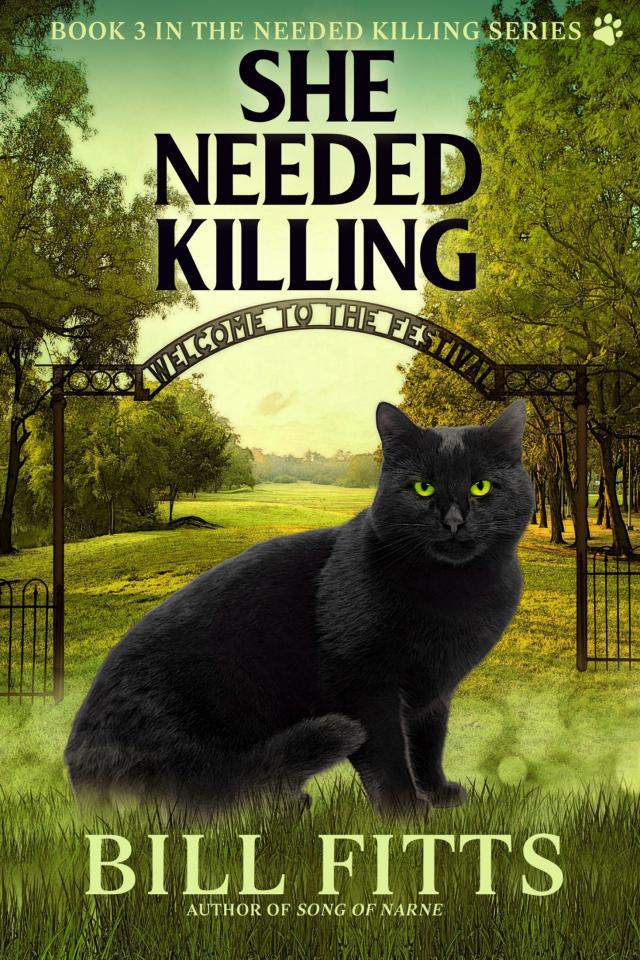
She needed killing, p.1
She Needed Killing, page 1


Contents
Title Page
Copyright
Dedication
Characters
1 - Tuesday
2 - Thursday Morning
3 - Thursday Afternoon
4 - Early Thursday Evening
5 - Thursday Evening
6 - Later Thursday Evening
7 - Later Still Thursday Evening
8 - Friday Morning
9 - Friday Lunch
10 - Friday Afternoon
11 - Friday Evening
12 - Saturday Morning
13 - Saturday Lunch
14 - Saturday Afternoon
15 - Saturday Evening
16 - Sunday Morning
17 - Sunday Lunch
18 - Sunday Afternoon
19 - Sunday Evening
Keep Reading for a Preview
The Busybody Needed Killing - Thursday Lunch
Acknowledgments
About the Author
Books by Bill Fitts
She Needed Killing
Book 3
in the
Needed Killing Series
Bill Fitts
Copyright 2013 by Bill Fitts
Excerpt from The Busybody Needed Killing
copyright 2014 by Bill Fitts
Smashwords Edition
All rights reserved.
This is a work of fiction. Shelbyville and the people (and pets) who populate it are either products of my imagination or used fictitiously. It would be idle to deny, however, that Shelbyville, along with its university, was inspired by my hometown, Tuscaloosa, Ala., and its environs.
ISBN 978-1-941387-04-7
Cover design: Keri Knutson at Alchemy Book Covers
Printed in the United States of America
billfittsauthor.com
For Anne,
without whom this book too never would have been written,
and for my mom,
who wanted her kids to love what they did for a living
Characters
Coba Boucher assistant director of The Festival
Crawford (James F. “Ford”) university retiree; private investigator
Stan Dowdy friend of Crawford; AV specialist at university
Dot Fields director of The Festival
Joyce Fines Festival board member
Ellen George Festival board member; married to Rufus George
Rufus George university provost; married to Ellen George
Ben Gibbons an immigration lawyer
Jack Harlon friend of Bobby Slater; married to Rebecca Perry
Chad Harris artist at The Festival
Harry Johns homicide investigator, Shelbyville
Levi Keith gospel singer; married to Mary Keith
Mary Keith Crawford’s house cleaner; gospel singer; married to Levi Keith
Ted Lowe artist at The Festival
Lenora Maisano Festival board member
Frank Manning University Press employee
Morgan Moore (Dr. Snake) Shelbyville native and snake expert
Mr. Whiskers Bobby Slater’s cat
Guy Nelson chief of security for The Festival
Pauline Frank Manning’s date
Rebecca (Bex) Perry Bobby Slater’s sister-cousin; married to Jack Harlon
Paul Simms Stan Dowdy’s assistant
Bobby Slater Crawford’s lady friend; University Press employee
Mose Smith owner of Mo’ Music; sound specialist at The Festival
Kurt Snoddy chief of police, Archibald
Ralph Stark head of volunteers at The Festival
Tan Crawford’s dog
The Black (TB) Crawford’s cat
Sammy Thompson sheriff, Jemison County
Jim Ward friend of Crawford; head of homicide, Shelbyville
Whittlin’ Woodrow artist at The Festival
1
Tuesday
"APPROVING LICENSE APPLICATION for private detective for James F. Crawford." My heart jumped. I had known that it was coming. After all, it had to be printed in the paper, but even so it was exciting to see it in black and white—or newsprint and ink. Someday there will be the Internet equivalent of publishing notices in the local newspaper—but not yet. There it was, an item on the Shelbyville City Council agenda for tonight. The agenda for a meeting I wasn't going to miss.
Alabama doesn't have statewide licensing for private investigators—just a state business license. The cities and towns are allowed to set their own requirements. In Shelbyville, the standard wording was "for private detective and uniform security guard" but I'd kicked up a ruckus on that. Evidently most people petitioned to be both private investigator and security guard. Since I couldn't see myself working as a rent-a-cop for fraternity parties, I'd made sure to limit the petition to just private investigation. It seemed like a reasonable thing to do at the time.
I was sitting at my kitchen counter reading the paper. I smoothed out the notice making sure there weren't any wrinkles in it. My dog, Tan, and I had done our morning walk. I'd showered, shaved, and dressed for the day before making breakfast. My current uniform—shorts, T-shirt, and sneakers—had been a comfortable change from my preretirement garb. Not that, as a geek, I'd been required to go the coat and tie routine. But there is casual and then there's casual.
Eventually the weather would force me to move to long sleeves and long pants. October in Alabama can have some cool days—it can also be as hot as June and July, which is why I was still in shorts. I hadn't been retired from my day job for a year as yet, so I was learning on the job, as it were, about retiree apparel.
Once the city council approved my application I was going to have to start saying that I was retired from the university and "in between jobs" in my new career. I smiled to myself. What do private detectives wear to work anyway? I was pretty sure that I wouldn't have to run out and buy a new wardrobe.
Retirement had altered some things, but breakfast hadn't gone through much of a change. Today was sausage biscuits with mustard and cheese. The cheese was a culinary wrinkle in my breakfast biscuit world that a new friend had introduced me to. Well, she wasn't really a new friend—it was the degree of friendship that was new.
I had opened up the News to get the morning started. I had my ritual for reading the newspaper. It was based in part on how I read the Saturday Evening Post when I was growing up. I think it was the Post. I started at the back since that's where the cartoons were and worked my way to the front. Same story with the newspaper. Comics, sports, local news, and finally the national news and editorials. Certainly I had not started with the city council agenda until recently.
I checked the back of the page the council agenda was printed on and decided that I'd forgo whatever story it was a part of. I stood up, got a pair of scissors out of the catch-all drawer, and headed to the table in the breakfast nook. I wasn't going to risk tearing the agenda item.
Once I'd spread the newspaper out, The Black jumped onto the table, walked across it until he was in the middle of the newspaper, and sat down. "Thanks," I scratched the cat's ears. "Now get off the newspaper—and the table." The commanding tone I used fell on deaf ears and I knew from experience how successful such entreaties would be. So I picked him up and poured him onto the floor. I had the agenda cut out of the paper before he got back on the table.
I tucked the clipping away in a folder I had sitting on the kitchen counter. There were a couple of other items in it, all things I thought I should do something with, but couldn't decide just what. Occasionally I'd flip through the folder item by item, decide I'd been wrong about one of them, and throw it away. But usually I just saved them all for another day.
In the folder were articles from the News about my old boss Sean Thomas dying from food poisoning, one about the accidental death of Albert Worthy, and another reporting the arrest of the person who'd killed both of them. There was an odd editorial from the student newspaper in which I was depicted as the provost's secret agent. It attempted to paint an ordinary business arrangement as mysterious and covert but was offset by the nearly universal respect accorded the provost. More News articles about the shooting of the University Press's director, the suicide of the last member of a once-prominent Shelbyville family, and another call for increased campus security from the student newspaper.
The folder contained, in fact, a history of events that had led to my applying for a private investigator's license. Maybe I should make a scrapbook. I shrugged. My muse must be busy somewhere else. I closed the folder to await another day.
Things had been slow in the detecting business since those two weeks in September that had dumped me headfirst into my new career. If by slow I meant nonexistent. But that was okay since it had taken until the middle of October for my application for a license to get on the council's agenda.
Today would be the start of my licensed career. My business cards were supposed to be ready so I'd stop by the printer and pick them up—along with a small supply of invoices, envelopes, and letterhead. I hadn't thought to order those items until the graphic artist I was working with brought it up. Since then I'd received her invoice with a pleasant cover note on her letterhead, all enclosed in an envelope sporting her business logo. I could see how handy these things were going to be. Along with the business credit card my accountant had strongly encouraged me to get. At least her suggestion was more altruistic than the artist's—having my business expenses separate from personal spending was going to make her job easier and she billed by the hour.
I'd been told that the council's approval of my application was all-but-assured. Still I'd been encouraged to attend the meeting and to try and appear as if I was a solid citizen. I assumed that meant wearing a suit and tie since that's what our politicians always wear. Misery loves company. Of course it might be they wore suits just in case a funeral happened to pop up.
The fact that I was going to be wearing a suit had prompted me to think at first that it would be a good time to take Bobby out for a celebratory meal. We'd started to go to Trey's one evening—gotten as far as being seated—but I'd gotten distracted by the outfit she was wearing, and we ended up back at her house and, eventually, had a late supper. Operating on the principle that "life is short; eat dessert first," we'd gone straight for dessert.
Retirement isn't the end to life, it's a beginning. I was glad I'd taken early retirement, and my new relationship with Bobby was one of the reasons. Bobby was short for Barbara. She'd put the y at the end in honor of Bobby Kennedy. And she put a smile on my lips every time I thought about her.
But the council meeting didn't start until six o'clock, I wasn't first on the agenda, and she had to go to work tomorrow. So the celebratory meal was on for tomorrow night—Wednesday evening that is. I'd made reservations for six o'clock. This time we'd save dessert for after dinner.
And, at the end of the week, across the river in Archibald, was The Festival. It had been an annual event for going on thirty years now, part folk festival—arts and crafts, primitive and contemporary—music festival; outdoor performances; and food. As close as it is to Halloween, costumes abound at The Festival. Sunday was Bring Your Pet to The Festival Day; Saturday celebrated Alabama beer and wine; and Friday—opening day—was the day to shop before the artists sold out of what you wanted. Thursday was the day I'd promised to meet Stan so he could shoot a video promoting The Festival. He'd asked if I'd bring The Black with me since he wanted a black cat in the video—what with Halloween coming up.
Remembering this, I guiltily looked around to see if The Black was still around. I'd neglected to mention to him that Stan wanted to video him at The Festival since this involved riding in the car, which meant he had to be in the cat carrier. Historically, this is not one of the things TB enjoys. And after the photo shoot, I was going to take him to the vet for his annual shots though I wasn't sure he was going to appreciate my rationale: he was going to have to go to the vet's anyway—what harm was a short delay?
I'd brought the carrier out from storage yesterday and put it down on the floor in the den. The Black had sniffed at it. So had Tan, who couldn't fit into it even if she'd wanted to. Then they had both ignored it. So far so good.
I went back to the clippings folder, opened it up, and wrote a note on the inside cover—Tan and The Black. I was careful to use seniority in determining priority. If this was going to be a history of my detecting career I needed to include my confidants.
I looked around the kitchen. Tan was on one of her dog beds and The Black was curled up asleep in a patch of sunlight on the floor. I, James F. Crawford, Private Investigator, went to clean out the kitty litter. Best not to get too puffed up about myself.
That evening The Black followed me into the bedroom as I was getting out of my suit and into something more comfortable. He was fussing about something—probably my not paying him enough attention—but I wasn't paying much attention. "You know TB, I don't think I do my best work in a suit. Maybe it's the tie."
I don't know what I'd expected the City Council meeting to be like but I had found it unsettling. The council room was impressive—heavy wooden paneling—twenty-foot-plus ceiling—rectangular—wider than it was deep. Seating for the public was sort of pew-like to your right as you entered the room. Across the room the civil service types sat behind some railing like where the choir would have been, if it had been a church—but there wasn't an altar. No, no altar—just an imposing wooden wall behind which city councilmen and -women sat in high-backed leather chairs on a raised platform—looming over the populace. They had the high ground for sure.
The room was old but it had been retro-fitted with the amenities—air conditioning, sound system, microphones, projector screens, laser pointers, computers, wireless network, and the like. Everything you needed to conduct today's business of governing but they'd left that part alone—the part that made it clear who were the governed and who governed.
I had sat there waiting my turn in my suit and tie, dress shoes freshly shined, file folder in my lap, cell phone turned off—the picture of a dutiful applicant—while the council worked its way through tonight's agenda. I was the fourth item—not counting the pledge of allegiance, opening prayer, and approval of last meeting's minutes. I was so nervous that it was a wonder butterflies weren't flying out of my ears.
It was clear that the first three items were routine by the way everybody was only half paying attention—almost sleep walking. The city clerk would read a summary of the application, city attorney murmur that there was no legal reason to deny it, police department representative say the police had no problem with it, the applicant would walk to the podium, no one would have any questions, council chair would bang his gavel, ask for a motion and then a second, get mumbled responses, ask for ayes and nays, slam the gavel again, and say "approved." Then it would start all over again.
I'd been so hypnotized by the routine that I found myself standing at the podium wondering how I'd gotten there. I was still nervous. So nervous that I'd been surprised when the chair asked the clerk a question and broke the routine.
"This the guy who caused all the trouble? The uniformed guard thing? Changing the application?"
"Yes, sir."
He frowned and leaned forward to peer down at me. So far no one had asked me a question so, for once, I had kept quiet. I had a sinking feeling that it might have been wiser to have let the joint application stay joint.
Another councilman stirred in his seat and leaned forward to peer at me too. "The same one that Rufus George wrote to us about?"
"Yes, sir. Same one." The clerk was positively verbose.
The second councilman shook his head. "Interesting."
The application had required references and Rufus had agreed to be one. I wondered just what Rufus had written. After all he'd gotten me started doing this.
"If he's good enough for Rufus George, he's good enough for me." A councilwoman looked up from the file folder she'd been reading and looked at me over her half-moon glasses. "I move to approve."
The second councilman leaned back. "Second."
The chairman shook his head. "Troublemaker." He leaned back. "Any opposed say 'nay.'" There was silence. "Those for approval say 'aye.'"
Scattered "ayes" were uttered by the council.
Slam. "Approved. Next."
"So, I got approved all right. Maybe it was the suit. I can pick up my license tomorrow afternoon at city hall." I picked up TB and draped him over my shoulder. He began to purr. "Because mine has to be specially made."
2
Thursday Morning
THE BLACK WAS in his carrier nestled in the backseat of my car. He wasn't happy. I could tell because he wasn't suffering in silence. He wasn't suffering at all as far as I could tell. This was the same carrier that he sometimes slept in while it was out, but he didn't care for it once I closed its door while he was in it. And when I put it in the car and we drove off? At least he'd settled down into an angry silence with an occasional mew of protest at any change—whether it was direction, speed, or road surface.
I pulled into The Festival grounds and was surprised to see what it looked like before it had its party face on and all the artists, vendors, and festival-goers descended on it. There were volunteers setting up the festival grounds. Wide pathways had been created over the years and people were raking them smooth, clearing out the underbrush on either side of the paths, repairing fencing, staking out booth locations—so you could see the skeleton, if you will, of The Festival being put together. Tomorrow the bones would be clad in booths and festival goers.






