

Creature, p.1
Creature!, page 1


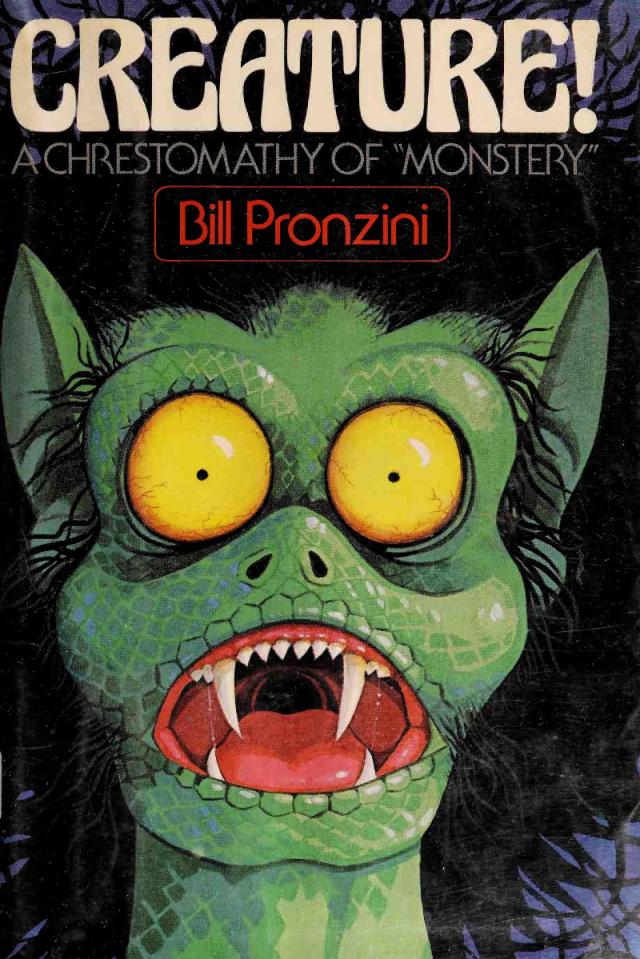
CREATURE!
They come out at night: the Yeti of the Himalayas, the Sasquatch of North America, the Loch Ness Monster of the Scottish Highlands… Are they figments of our imagination? Or are they real creatures that elude and defy scientific explanation?
For thousands of years, every continent, every race —civilized as well as primitive — has had its creature “legends.” Each has provoked speculation, prompted investigation, been a source of fascination — and fear. Assembled here, for the first time, are the best and most unusual tales of creatures strange, wonderful — and terrifying, by the creator of Werewolf!, Voodoo! and Mummy!
A true connoisseur’s collection, Creature! includes works by such masters as Sir Arthur Conan Doyle, Robert Bloch, Barry N. Malzberg, Leslie Charteris and Talmage Powell — and is sure to enthrall skeptics and ready believers alike.
CREATURE!
NOVELS BY BILL PRONZINI
The Cambodia File (with Jack Anderson)
Labyrinth
Night Screams (with Barry N. Malzberg)
Twospot (with Collin Wilcox)
Acts of Mercy (with Barry N. Malzberg)
Blowback
Games
The Running of Beasts (with Barry N. Malzberg)
Snowbound
Undercurrent
The Vanished
Panic!
The Snatch The Stalker
ANTHOLOGIES EDITED BY BILL PRONZINI
Creature!
Mummy!
Voodoo!
Werewolf!
Shared Tomorrow (with Barry N. Malzberg)
Dark Sins, Dark Dreams (with Barry N. Malzberg)
The End of Summer: Science Fiction of the Fifties (with Barry N. Malzberg)
Midnight Specials
Tricks And Treats (With Joe Gores)
A CHRESTOMATHY
OF “MONSTERY”
CREATURE!
Edited by Bill Pronzini
ARBOR HOUSE
NEW YORK
Copyright © 1981 by Bill Pronzini
All rights reserved, including the right of reproduction in whole or in part in any form. Published in the United States of America by Arbor House Publishing Company and in Canada by Fitzhenry & Whiteside, Ltd.
Library of Congress Catalog Card Number: 80-70221
ISBN: 0-87795-310-4 cloth
0-87795-321-X Priam trade paperback
Manufactured in the United States of America
10 9 8 7 6 5 4 3 2 1
The following page constitutes an extension of the copyright page. The author gratefully acknowledges permission to include from the following:
ACKNOWLEDGMENTS
“The Terror of Blue John Gap” by Sir Arthur Conan Doyle. Published with the permission of the copyright holder of the Sir Arthur Conan Doyle literary estate.
“Creature of the Snows” by William Sambrot. Copyright © 1960 by William Sambrot. First published in The Saturday Evening Post. Reprinted by permission of Curtis Brown, Ltd.
“Waziah” by Joe R. Lansdale. Copyright © 1981 by Joe R. Lansdale. An original story published by permission of the author.
“Barney’s Bigfoot Museum” by Richard Laymon. Copyright © 1981 by Richard Laymon. An original story published by permission of the author.
“Survival Exercise” by Talmage Powell. Copyright © 1981 by Talmage Powell. An original story published by permission of the author.
“The Convenient Monster” by Leslie Charteris. Copyright © 1961 by Leslie Charteris. First published in The Saint Magazine (British edition). Reprinted by permission of the author.
“Daniel Webster and the Sea Serpent” by Stephen Vincent Benet. Copyright © 1937 by Stephen Vincent Benet; copyright renewed © 1965 by Thomas C. Benet, Stephenie B. Mahin, and Rachel B. Lewis. Reprinted by permission of Brandt & Brandt Literary Agents, Inc.
“Terror in Cut-Throat Cove” by Robert Bloch. Copyright © 1958 by Ziff-Davis Publishing Co. First published in Fantastic. Reprinted by permission of Scott Meredith Literary Agency, Inc., 845 Third Avenue, New York, N.Y. 10022.
“Notes Leading Down to the Events at Bedlam” by Barry N. Malzberg. Copyright © 1972 by Barry N. Malzberg. First published in Beware More Beasts. Reprinted by permission of the author.
“In the Straw” by Edward D. Hoch. Copyright © 1972 by Edward D. Hoch. First published inBeware More Beasts. Reprinted by permission of the author.
“Where Do You Live, Queen Esther?” by Avram Davidson. Copyright © 1961 by Avram Davidson. First published in Ellery Queenys Mystery Magazine. Reprinted by permission of the author.
“Wriggle” by John Lutz. Copyright © 1981 by John Lutz. An original story published by permission of the author.
“The Pond” by Nigel Kneale. Copyright © 1950 by Nigel Kneale. From Tomato Cain and Other Stories.Reprinted by permission of the author and Douglas Rae (Management), Ltd.
Contents
ACKNOWLEDGMENTS
INTRODUCTION
PART ONE LAND CREATURES
THE TERROR OF BLUE JOHN GAP BY SIR ARTHUR CONAN DOYLE
CREATURE OF THE SNOWS BY WILLIAM SAMBROT
WAZIAH BY JOE R. LANSDALE
BARNEY’S BIGFOOT MUSEUM BY RICHARD LAYMON
SURVIVAL EXERCISE BY TALMAGE POWELL
PART TWO SEA CREATURES
THE CONVENIENT MONSTER BY LESLIE CHARTERIS
A TROPICAL HORROR BY WILLIAM HOPE HODGSON
DANIEL WEBSTER AND THE SEA SERPENT BY STEPHEN VINCENT BENÉT
TERROR IN CUT-THROAT COVE BY ROBERT BLOCH
PART THREE OTHER CREATURES
STRANGE AND WONDERFUL NOTES LEADING DOWN TO THE EVENTS AT BEDLAM BY BARRY N. MALZBERG
IN THE STRAW BY EDWARD D. HOCH
WHERE DO YOU LIVE, QUEEN ESTHER? BY AVRAM DAVIDSON
WRIGGLE BY JOHN LUTZ
THE POND BY NIGEL KNEALE
BIBLIOGRAPHY
INTRODUCTION
They only come out at night.
If you are a wilderness traveler, whether on land or sea or other body of water, you must always remember this. Especially on dark nights, late, when the forest or the mountains or the water is hushed and no moon shines in an ebon sky. Especially if there are no other human beings close by, no one to hear a cry for help.
For no matter what the species—Yeti, Sasquatch, swamp beast, sea serpent, or other creature strange and wonderful—they only come out at night … and they come out to go a-hunting.
No, they seldom actually prey on human flesh; some are not even carnivorous. They make every effort^ in fact, to avoid contact with the race of man. But they are not afraid of man, nor are they unwilling to attack if provoked or frightened. Some are huge, with the strength of a hundred, a thousand puny humans; and all possess a cunning far greater than any in the mind of homo sapiens. They can be dangerous: when they are on the prowl for food for themselves and their young they must be avoided at all costs. If aroused, their wrath may be almost as great as God’s—and in a confrontation between man and creature, man almost never wins.
Or survives.
So be careful, traveler, and be vigilant. If you must walk by night, walk soft and wary. Otherwise remain in your camp with a high hot fire burning through the dark hours, or in your boat with all lanterns lit. Stay clear of caves and bog holes and dense swamp thickets. Do not sail into uncharted waters or too near unknown shores. Do not investigate cries or rustlings or other strange sounds in the darkness.
Mark the words of Coleridge’s Ancient Mariner, if you mark no others:
Like one that on a lonesome road
Doth walk in fear and dread,
And having once turned round, walks on,
And turns no more his head;
Because he knows a frightful fiend
Doth close behind him tread.
Fiend—or creature—remember these words well. And remember, too, that most important fact of all. You will receive no other warning, and if you fail to remember, if you fail to heed, the consequences are frightful indeed:
They only come out at night …
There have been sightings of land and water creatures for thousands of years. On every continent, on every sea and inland body of water, man has encountered and often done battle with beings of myriad type and description. Every race, civilized as well as primitive, has its creature legends; and every race has its believers, its worshipers. This is as true today as it was a hundred or five hundred or five thousand years ago.
Creatures, monsters, do exist.
Until the last century, that was a claim only whispered, if spoken at all. Fear and superstition precluded open discussion, much less a sustained scientific interest in such phenomena. The advancement of modern civilization, and the shrinkage of the world that came with it, brought the question of creatures into the open. And people began to speak of the unspeakable.
In 1887 Lawrence A. Waddell, a major in the medical corps of the British Indian Army, found a series of large tracks in Sikkim and caused something of a stir in England by attributing the tracks to “a creature, not a man” in his 1899 book Among the Himalayas. In 1902 British Indian officials stringing the first telegraph wire between Kalimpong, in northern India, and the capital of Tibet, Lhasa, filed a report stating that a dozen native workers had vanished near a place called Jelep-La on the Sikkim-Tibet border, and that during a search for them a huge hairy creature was found asleep under a rock and summarily killed by soldiers. (What happened to the body no one knows.) In 1915 a British forestry officer named J. R. O. Gent wrote in a letter to scientific explor er H. J. Elwes, who himself had seen a creature some years before, that he had found evidence of a “big monkey, or ape perhaps—if there were any apes in India” near Phalut in the outer Himalayas.
These are just three of dozens of early reports from India, Tibet, Sikkim, and Nepal of the creature known variously as the Metoh-Kangmiy the Yeti, and the Abominable Snowman (ABSM for short). The majority of these reports, whether made by Westerners or Tibetans, Sherpas, and other natives of the region, coincide in their descriptions of what the creature looks like: four to ten feet tall when erect on its hind legs (several different species have been theorized by scientists); massive body covered with dark brown or occasionally lighter colored hair; long arms; oval head pointed or ridged at the top, with an apelike face only sparsely hirsute. It is said to possess great strength and a peculiar whistling call like that of a seagull, and—survivors say—to fear the light of a fire.
Later scientific investigation has evidently established the fact that the term “snowman” is a misnomer: the creature is not human, nor does it live in the snow. Its habitat is the impenetrable forests below the Himalayan snowline, where it sleeps by day in a hidden lair and goes foraging at night. In the forest it may move on all fours or by swinging apelike through the trees; in the open it walks upright in a rolling, somewhat unsteady fashion. The reason it treks up into the snow regions, according to speculation, is that it craves certain lichens, found on the rocks of the moraine fields, which are rich in vitamin E and minerals.
Until 1954 the world at large knew relatively little about the Yeti. In that year, spurred by reports of creature tracks and sightings by famed mountaineer Sir Edmund Hillary, among others, the Daily Mail of London organized the first expedition aimed at finding an ABSM. This expedition was led by a reporter, Ralph Izzard, and included a zoologist among its members, and although it uncovered little new information (and no ABSM) on its year-long trek through the Himalayas, it served the dual purpose of publicizing the Yeti phenomenon and pointing the way to serious scientific attempts at solving the enigma.
Several other expeditions followed, notably three led by a prominent Texas researcher named Thomas B. Slick; most of these found and photographed Yeti tracks, and some ABSM were sighted in and out of the snow regions. These additional discoveries added fuel to both public and scientific interest. A number of ‘ABSM books—some scholarly, some sensationalistic—began to appear. More expeditions were organized, and continue to be organized, by men searching for more specific data.
But to the date of this writing no one has succeeded in capturing (or in killing) a Yeti, or even in locating one of its hidden forest lairs. The true nature of the beast remains a mystery.
The Sasquatch, or Bigfoot, of North America is believed by many to be either a western hemispheric cousin of the Yeti or a breed of ABSM which migrated to a warmer climate from Asia across the Bering Sea and down the Pacific coast. In either case, the central domain of Sasquatch appears to be British Columbia, Washington, Idaho, Oregon, and northern California. Its habitat may range as far east as the Dakotas, as far north as the Alaskan interior.
Reports of huge hairy creatures that walk on two legs—of “wild men of the woods”—have emanated from the Northwest since the early 1800s. One of the more interesting of these appears in a book entitled Wilderness Hunter {1893), written by Theodore Roosevelt in his pre-White House years. It relates a story told to Roosevelt by a grizzled old mountain hunter named Bauman.
In his younger days Bauman had gone trapping with a partner in Idaho, and,
not having much luck, he and his partner determined to go up into a particularly wild and lonely pass through which ran a small stream said to contain many beaver.
The pass had an evil reputation because the year before a solitary hunter who had wandered into it was there slain, seemingly by a wild beast, the half-eaten remains being afterwards found by some mining prospectors who had passed his camp the night before.
The two men found much more than they bargained for. Twice in the next two days their camp was visited while they were out setting traps, their things rummaged through, and the lean-to they had built (and then rebuilt) torn down. The ground was marked up by tracks which Bauman swore were made by a creature walking on two legs, a creature that could not have been a bear.
On the third day he and his partner determined to leave the area. They spent the morning retrieving all but three of their traps, feeling the while as if they were being followed. Bauman set out after the remaining traps while his friend returned to the camp to make their packs ready. When Bauman himself returned he found
the body of his friend, stretched beside the trunk of a great fallen spruce. Rushing towards it the horrified trapper found that the body was still warm, but that the neck was broken, while there were four great fang marks in the throat.
The footprints of the unknown beast-creature, printed in the soft soil, told the whole story…. It had not eaten the body, but apparently had romped and gambolled round it in uncouth, ferocious glee, occasionally rolling over and over it; and had then fled back into the soundless depths of the woods.
In British Columbia alone more than one hundred and sixty Sasquatch incidents have been documented, ranging from sightings and the discovery of tracks to attacks on human beings. Most of the eyewitness accounts agree that Bigfoot is similar to Yeti in appearance: seven to ten feet tall, long dark brown (or in some cases black) hair, weight in the neighborhood of three hundred pounds, with pointed head and apelike face. The females sighted are said to have huge, pendulous, hair-draped breasts.
(There exists a film of one such female, taken by Roger Patterson, head of the Bigfoot-oriented Northwest Research Association, while exploring “Bigfoot Country” northeast of Eureka, California, in 1967. Rounding a bend on horseback, Patterson and a companion came upon the creature opposite a shallow stream some one hundred yards distant; Patterson ‘managed to load his movie camera and to shoot several feet of film as he chased the creature into the woods. Dr. John R. Napier, director of Primate Biology at the Smithsonian Institution—and later author of a superior book called Bigfoot: The Yeti and Sasquatch in Myth and Reality—was among those who viewed the film. His comment is significant: “I observed nothing that, on scientific grounds, would point conclusively to a hoax. I am satisfied that the walk of the creature shown in the film was consistent with the bipedal striding gait of a man. The bodily proportions of the creature, as far as could be seen, appeared to be within the normal limits for man. The appearance of the high crest on top of the skull is unknown, but given a creature as heavily built as the subject, such a biochemical adaptation to an exclusively fibrous raw vegetable diet is not impossible.”)
In May of 1967 the evident corpus delicti of a Bigfoot-type male went on exhibit in a refrigerated van attached to a traveling show in the Midwest. Eminent ABSM authorities Ivan Sanderson and Dr. Bernard Heuvelmans learned of this and, wary of a hoax, subsequently examined the creature in December of 1968. They found it to be shaped like an adult human male, some six feet tall and covered with dark brown hair several inches in length. The skin beneath it was a pale white. The hands were almost human except for overlong thumbs; the feet measured eight inches across the toes and were covered with thick hair. The face was large and pugged, more like a Pekingese dog than a gorilla or a man, with large circular nostrils, wide mouth with no visible lips, and small teeth dissimilar to those of either ape or human. Around the mouth were folds and wrinkle lines which Sanderson found to be “absolutely human … like those seen in a heavy-jowled, older white man.”






