

The wrong un, p.1
The Wrong 'Un, page 1


GREG GROWDEN was a senior sportswriter for the Sydney Morning Herald for more than three decades. He left the Herald in late 2012 to become the Australian rugby correspondent for the ESPN network and Scrum.com. He is the author of thirteen books, including three cricket titles.
Published by Nero,
an imprint of Schwartz Publishing Pty Ltd
Level 1, 221 Drummond Street
Carlton VIC 3053, Australia
enquiries@blackincbooks.com
www.nerobooks.com
Copyright © Greg Growden & Brad Hogg 2016
Greg Growden & Brad Hogg assert their right to be known as the authors of this work.
ALL RIGHTS RESERVED.
No part of this publication may be reproduced, stored in a retrieval system, or transmitted in any form by any means electronic, mechanical, photocopying, recording or otherwise without the prior consent of the publishers.
National Library of Australia Cataloguing-in-Publication entry:
Hogg, Brad, author.
The wrong ’un: the Brad Hogg story / Brad Hogg, Greg Growden.
9781863958783 (paperback)
9781925435290 (ebook)
Hogg, Brad. Cricket players—Australia—Biography.
Cricket—Australia—Biography.
Growden, Greg, author.
796.358092
Cover design by Peter Long
Text design and typesetting by Tristan Main
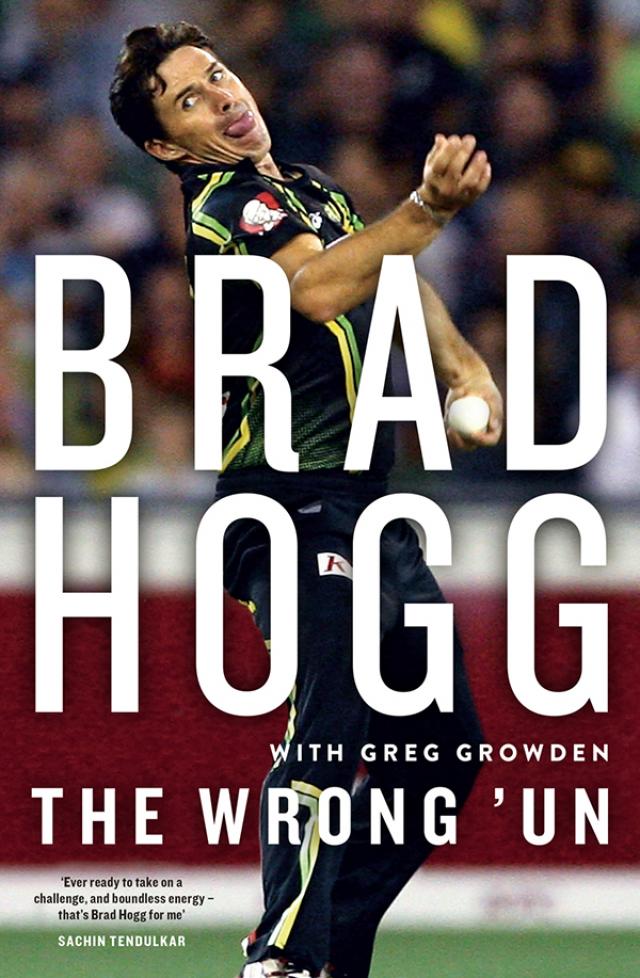
Front cover photograph by Robert Prezioso/Getty Images
Back cover photograph by Indranil Mukherjee/Getty Images
Dedicated to my parents,
who, after reading this book,
might never speak to me again …
CONTENTS
Preface by Greg Growden
1. The World’s Biggest Backyard
2. One More Bucket of Balls
3. Get Behind the Ball Now, or Piss Off
4. School Days
5. Becoming a Man
6. Don’t Give Up
7. Wet Behind the Ears … and Up Front
8. The Spinners’ Union
9. First Test Jitters
10. The Underdog
Picture Section
11. Return to Sender
12. World Cup Glory
Trouble in Paradise by Greg Growden
13. England and Other Haunts
14. The Country Bumpkin
15. Unlikely Hero
16. The Collapse
17. Back from the Brink
18. Subcontinental Adventures
19. Twenty20 – the Future
20. Red-Hot Scorchers
21. Becoming a Renegade
22. Chasing the Dream
Acknowledgements
PREFACE
by Greg Growden
‘Hoggy, Hoggy, Hoggy …’ The chant reverberates around the WACA ground. As he starts doing windmills with his arms, the volume increases: ‘Hoggy, Hoggy, Hoggy …’ He flexes his muscles and it intensifies: ‘Hoggy, Hoggy, Hoggy …’
When he’s handed the cricket ball and deceives an opponent, or when he runs towards the boundary fence, grinning and winking at the crowd, and especially when he pokes out his tongue, the fans are off and away. They bow, they yell, they laugh, they cheer. They are on his side. It seems to lift him, making him want to provide those supporting him with something else to cheer about.
Crowd chants at the cricket are not unusual. What makes this one different is the target. This is hero worship of a different kind.
For many seasons George Bradley Hogg enjoyed a special affinity with the crowd at his home ground, especially when the Perth Scorchers were in town and the WACA became ‘The Furnace’. Well past his 40th birthday, Hogg continued showing up others half his age. He became a cult hero for the masses.
But now it is time for a new challenge. A new market. A new opportunity. The Melbourne Renegades have beckoned him across the continent from Perth, eager for him to become one of their key bowlers in the 2016–17 Big Bash. At Etihad Stadium he’ll meet a new home crowd, and no doubt he will convince them that he’s worth believing in – and chanting for.
Even a supposedly over-the-hill 45-year-old can find new goals on the cricket field. Especially when he doesn’t want to get eased off the big stage, and is convinced he can still contribute.
Hogg is now well into his third decade of professional cricket. He has represented Australia in all forms of the game: he played seven Tests, he took 156 wickets in his 123 one-day internationals at an average of 26.84, and he was involved in two successful World Cup campaigns, not to mention two Twenty20 World Cups. He also won two Big Bash titles with the Scorchers. Yet he is far from finished, and plans to continue playing top-level cricket until the age of 50.
Hogg plays for the sheer joy of the game. He has loved cricket since he was a toddler, following his ‘Bradman of the Bush’ dad around. He’s proved that retirement doesn’t have to be permanent. He got a second chance and reinvented himself, and he continues to thrive in Twenty20 cricket leagues around the world.
As for Hogg’s ever-present tongue – well, it has a life of its own. It’s been like that since he was a kid. When he pokes it out it just means he’s concentrating, but he’s been teased about it plenty along the way. Maybe that crazy tongue is one of the reasons the crowd relate to him.
He’s a player who loves making the fans’ experience of the game enjoyable. Hang around after a Big Bash game, and you’ll see Hogg out on the ground signing autographs until there are no more requests. He’s been a cricket fan all his life too, and he doesn’t want to disappoint anyone.
However, it wasn’t that long ago – just a few years – that he had nothing to cheer about. And no one was cheering for him. Hogg had stopped believing in himself, and lost his way. That’s one of the reasons he is now sharing his story: in the hope that he’ll inspire you to keep believing in your dreams too.
Hogg’s Test captain, Ricky Ponting, once wrote: ‘I can’t stress how important blokes like Hoggy are to the psyche of a cricket team on tour. Sometimes, their off-field selflessness and good humour can be just as important for a team’s progress as a hundred made on the park.’ When he learned of Ponting’s tribute, tears welled in his eyes. His granddad always said that being a good team man was worth more than a load of trophies for individual performances.
This is the story of a boy from the bush, a cricketer who stumbled over some big hurdles and went through some tough times. But it’s also the tale of a passionate man who stuck at it and achieved what he set out to do: play for Australia and wear the baggy green.
1.
THE WORLD’S BIGGEST BACKYARD
‘Sue had enormous determination and a will to do well in anything she tried. Couple that with Greg, who is definitely the same … No wonder we had such a product in Bradley.’
Colin Macnamara, Brad’s first cricket coach
My first cricket recollection is sitting on our old green couch watching the 1975–76 Test series on our black-and-white TV, and getting really upset that the West Indies were giving Australia such a hard time. I was four years old. I’d developed a taste for cricket as a toddler, wandering around the country grounds where Dad played, but that Perth Test match took my interest to another level.
My other memory from that time is of the Australian opening bats getting pummelled by the West Indian pace attack. I kept thinking to myself, How tough are these Australian batsmen? It didn’t matter whether they were winning or losing; I was intrigued by the tactics of the match and the approach of the players.
I could not have wished for a more extreme match to introduce me to Test cricket. The First Test, on a wet wicket in Brisbane, had been dominated by Greg Chappell’s Australian team, but in Perth that was reversed. The West Indian batsmen relished the pace and bounce of the WACA pitch, and fearlessly took on the exceptional Australian bowling attack.
Opening batsman Roy Fredericks was in a particularly courageous mood. He was not deterred by Jeff Thomson bowling the fastest ball then recorded – 99.68 miles per hour – and he bobbed, weaved, hooked, cut and drove his way to one of the best Test centuries scored at the WACA ground. Decades later, Fredericks’ exceptional innings is still discussed. It’s one of the few times the formidable Australian bowling attack of that era was tamed.
It was clear what Fredericks’ intentions were. The second ball he faced was a bouncer from Dennis Lillee, and it ended up in the crowd. The Australian bowlers also played into his hands. As Chappell later said, they were trying to knock his block off and bowled too short, and Fredericks responded with cavalier batting. He scored his 169 runs off 145 balls, with 27 boundaries and a six.
Clive Lloyd was also on song, and the Windies finished with 585 in their only innings at bat. Then Andy Roberts took seven second-innings wickets, and the Perth Test was over and done with well before lunch on the fourth day.
Even though Australia went on to win the next three Test matches and dominate the series, the Perth debacle stuck in my memory for a long time. These big men from an unknown place seemed fearsome, mysterious. Seeing the power of the West Indian batting, and then the aggressive Roberts dismissing the top seven Australian batsmen – Rick McCosker, Alan Turner, the Chappell brothers, Ian Redpath, Rod Marsh and Gary Gilmour – left an indelible mark on me.
After watching that West Indies Test each day, I turned off the television, headed out to a concrete path in our backyard and pretended that I was playing the innings that would save Australia. I was the Australian captain, going out there
*
To get to our place, you head two hours south of Perth, 150 kilometres or so along the Albany Highway. The rich green of the coast disappears when you leave the suburbs and head out over the hills, and after a stretch of bitumen that meanders through forest, large sprawling properties appear, dotted with tall gum trees.
It’s a landscape of wheat and sheep, as well as flat plains, hills and dust. The heat is dry, the sun high and the light bright. There’s often a glare. You can easily imagine a swagman wandering down these tracks. Somewhere on the horizon you will always see swirling dust from tractors, harvesters or utes, either preparing the ground, reaping a crop or just getting to the next job. Almost everything has a brown, burnt tinge – and if it doesn’t, it soon will, especially if it’s a bold summer. Bushfires are common. The land is parched, and the smallest spark can lead to blackened paddocks and threatened homesteads.
The smell of the area is a mixture of soil, red dust, sweat, oily wool, and eucalyptus. It is a gritty, earthy mix, even a little sweet when harvesting is completed and paddocks are just stubble. As the locals say, that smell never gets out of the back of your nostrils.
The land here is fertile, but everyone still does it hard, especially when there’s no rain. They earn every cent; there are no handouts out this way. With the uncertainty of the weather, they depend on endless paddocks devoted to different crops and large harvests to keep them going, diversifying with several hundred head of sheep when wool and meat prices are on the up. There is always something to do. If you’re not willing to work long hours, you don’t make it. Only the persistent remain – families like the Hoggs and the Halls.
Here, in the middle of the wheat belt, the names of the towns are often matter-of-fact, like Williams and Darkan, but a few sing: Quindanning, Dumbernine, Narrogin. Some have signs showing you exactly where these towns are; some have a small collection of shops, usually a variety store and a petrol station. These towns are neat and serve their purpose, but soon disappear in the rear-vision mirror.
Some, like Tarwonga, which is just a speck on the side of the main Albany Highway, don’t even have a sign. If you didn’t know it was there you would drive right past it, not realising you had just passed a venue where Test cricketers have made an appearance. You have to know exactly where to veer off the main road and head down a track. Once you pass some stunted trees, the track opens up majestically to show off a paddock, an oval, well-kept tennis courts, some swings, a neat and tidy toilet block and an impressive galvanised-iron community hall, which booms and rattles during a storm.
The Hoggs and the Halls have been out this way for a long time. We are deeply entrenched, deeply proud locals of the Williams–Narrogin–Tarwonga region. We know all these tracks: every wide open road, and every sneaky shortcut.
My mum is a Hall, and her family ran the local newspaper for decades. My great-grandfather – Ernest Sydney Hall – was a tough character. Born in the New South Wales country town of Molong, he was expected to join his family’s butchery, but during the recession of 1902 he became angry about the terrible working conditions of the day and headed west to the wheat area, in the hope of a better future. His taste for newsprint came from a short stint as editor of the Trangie Times in western New South Wales; less than a year later, in 1905, he was on the other side of the country starting up a local paper named the Narrogin Observer.
It wasn’t long before Syd Hall was one of the town’s prominent figures, and a community leader. In a small town trying to establish itself, he understood how powerful the position of newspaper editor could be in swaying opinions and pushing agendas. He wanted to make sure Narrogin became a vital hub for the surrounding countryside, which was dotted with pioneers cultivating the land.
Syd Hall wasn’t always hospitable to those he thought were fools, or those who did not have the best interests of the town at heart. Many years after he died, his own newspaper did a feature about its founder, and focused on my great-grandfather’s stubborn nature. He was described as ‘a fearless and obstinate man of principle’ who ‘was not easy to like’. The Observer observed that ‘although the flaws in his nature limited his achievements, he was always endeavouring to make life better and to get the best out of others’.
His public life was busy, to say the least. He was a justice of the peace, served on many local court cases, was town mayor during the Great Depression and a councillor for many years, was involved in starting up the Narrogin Cooperative Butter Company and ensured that the St John’s Ambulance service was located in Narrogin. He was also a competent golfer.
He didn’t hold back in his paper’s editorials, and was often critical of the local council. He pushed hard for the local school of agriculture to be properly funded, and he was among those who demanded that the new railway pass through Narrogin. He resigned from council in 1920, and advised that his successor should ‘do nothing, say nothing, but agree spontaneously with what everyone else says. If he does this he will prove a howling success.’
Syd was just as angry when a town committee struggled to get anything organised during the Second World War, a time when there were even fears of a Japanese invasion of the area. He couldn’t stand anyone who procrastinated. He complained in an Observer editorial: ‘If the Japanese were coming over the cemetery hill, the Mayor would probably call a public meeting in order to decide what should be done. It is an even money bet that someone would suggest wiring Perth for instructions.’
Syd Hall had four sons – Norman, Ray, Clarrie and Vernon – and they followed him into the newspaper game. They were forthright like their father, and playing sport was very much part of their lives. Vern was my mum Sue’s father, my grandfather. He was a capable pilot, flying for the RAAF during the Second World War. He originally enlisted as a gunner, and so had a life expectancy of just six months, but on his third day – lucky for our family – he was reassigned and became a highly regarded flying instructor. After the war he was poached by MMA Airlines, which was later bought out by Ansett, to be a pilot, but family duties beckoned him back to Western Australia and the Narrogin Observer.
Granddad loved his sport. He was twice a state hardcourt tennis champion, and a tough footballer who didn’t take any prisoners. In one final he was asked to play at full back on the opposition’s star full forward, and after the player got a few early touches and had one goal to his name, Granddad gave him the full Leigh Matthews treatment and didn’t require any deodorant after the game.
What a treasure trove of trophies, medals and glittering goodies was to be found in Granddad’s back shed. I’d always sneak in there and marvel at the life he had led before he was my granddad and the old man I knew. But Granddad didn’t like to display his trophies. He instilled in me the belief that they didn’t indicate the true value of a person; it was what your teammates thought that mattered most.
Thirty kilometres west of Narrogin, the Hoggs made the area around Williams their domain. They were from sturdy country stock, and proud to be farmers. For generations they relied on sheep, wheat and a variety of other crops to pay the bills and keep the banks at bay. The Hoggs owned vast properties in the Williams region, and they were known as good, honest farmers who got through the tough times and made the most of the lush periods.
My great-grandfather, George Brown Hogg, had two sons, George Bruce and Barry. Barry took over the main farm, and he bought Bruce another property. Bruce was my grandfather, and he had three sons – George Gregory, Kennedy and Peter – and a daughter, Mary; my two uncles went onto the main farm, while Granddad helped my father, Greg, buy another farm, about twenty minutes out of town. Farming was in Dad’s blood and he ran sheep as well as growing barley and oats. He later bought a second farm to grow wheat.
The Hoggs were a family steeped in tradition, and one was that the eldest son of each generation was named George. To differentiate them, they were known by their second names. My father was named George Gregory Hogg and was known as Greg. That’s why my name is George Bradley Hogg. Although I’m mostly known as Brad, some of my closest friends still call me George.









