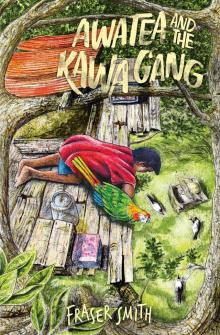
Awateas secret, p.1
Awatea's Secret, page 1


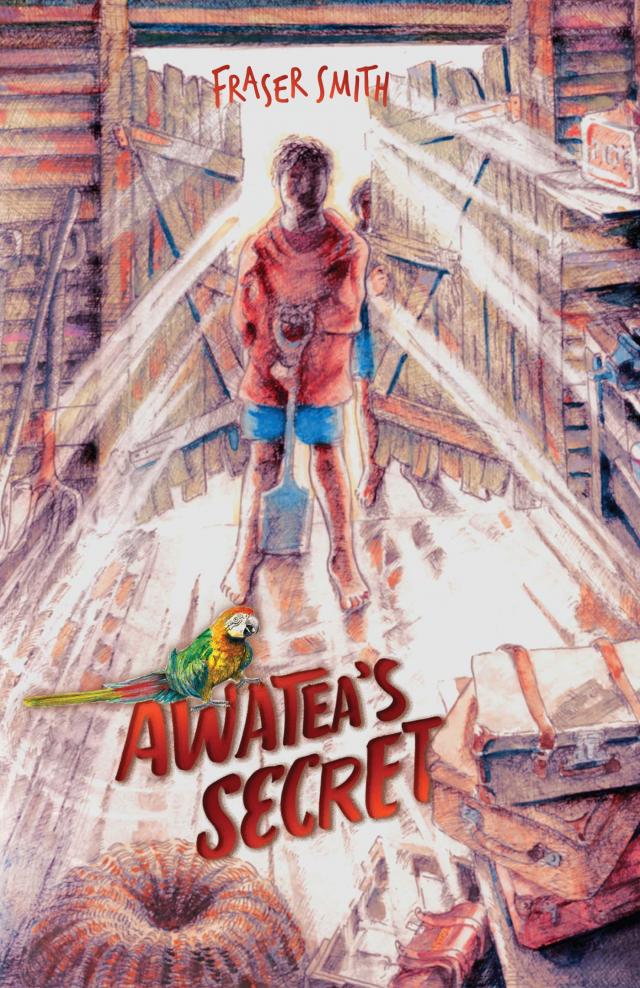
First published in 2024 by Huia Publishers
39 Pipitea Street, PO Box 12280
Wellington, Aotearoa New Zealand
www.huia.co.nz
ISBN 978-1-77550-828-1 (print)
ISBN 978-1-77550-873-1 (ebook)
Text copyright © Fraser Smith 2024
Cover illustration © Patrick White 2024
This book is copyright. Apart from fair dealing for the purpose of private study, research, criticism or review, as permitted under the Copyright Act, no part may
be reproduced by any process without the prior permission of the publisher.
A catalogue record for this book is available from the National Library of New Zealand.
Ebook conversion 2024 by meBooks.
To my uncles:
William, Patuone, Bob, Frank, Kim and John
Contents
1Patero
2Homestead Again
3Rats
4The Orchard
5Mr Carol’s Shed
6Kamikaze Visit
7Kawa Gang Detectives
8Mr Carol’s Junk
9Sleeping in Mrs Carol’s House
10J.D. Carol’s Satchel
11Manuhiri
12Mr Willy Tortoise
13Goodbye, Mrs Carol
14Carrot Comes to Civilisation
15Another Tree Hut
1
Patero
Darcy tugged, then growled through his teeth. He sat back on his haunches and jerked hard, ripping another hole in the lining of his smelly tartan coat, and it dropped from the door handle to the floor of the back porch. Darcy dragged it backwards down five concrete steps, his short legs straining to get a grip, his well-fed belly scraping on each step.
His backwards progress across the lawn with the tatty tartan changed direction each time he stopped to get his bearings. When he reached the pup tent, he wagged his tail and barked.
Awa looked up from hammering tent pegs into the lawn and laughed. “You silly sausage of a dog. Are you moving out too?”
Awa got to work tightening the ropes. Darcy dropped his coat under the awning.
“You want to sleep outside too, eh boy?”
Darcy wagged his tail, sniffed his coat and walked round and round on it in tight circles, his butt lowering a little more each time, until he finally slumped down with an exhausted grunt.
Awa laughed. “Ground sheet, sleeping bag, pillow, torch for me … and your smelly old coat stays out here, OK?”
Darcy’s tail slapped the coat, which released puffs of dust and dog hairs. He put his head on his paws and closed his eyes.
“You can be my ferocious guard dog.”
Awa lay on the lawn beside the dog and looked at the sky. He missed Carrot the parrot, Nan and Pop, Ma and Pa Rumble, Mangokuri and adventures. He was sick of living in town and going to school. Every day seemed the same. His dad was back at work. His mum was always busy. His three younger brothers had their own friends and, apart from Tai, had no idea of the wild world he was used to while living with his grandparents. He could camp out on the back lawn as long as he liked, but it was nothing like the Kawa Gang HQ, and Darcy was no Carrot.
“Oh well, it’s the best we can do. Summer holidays are coming,” he said to the dog.
Tai ran over. “Awa, Awa! What’s the tent for?”
“Mum said I can camp out. It’s not like the Kawa Gang HQ, but it’s better than the bunk.”
“Can I camp out too? We could tell Puhaha stories.”
Awa thought about it. Tai had been a loyal Kawa Gang member. He had been slashed by the Kamikazes’ sharp beaks. He had helped chase away Flip-Top Head the leopard seal and his mate and had got lost in a tapu burial ground and been rescued by Carrot. They both had shares in the ambergris treasure, although Tai didn’t know about the other money hidden in Awa’s bank account. And he had helped catch the poachers.
“Tai, we’ve got to convince our parents that we need a holiday at Nan and Pop’s.”
“I’m into that, all the way, Awa!”
That night in the tent, instead of telling
Puhaha stories, they talked about their Kawa Gang adventures and planned how they would sleep in Mrs Carol’s haunted house. Lying in the dark, they made a mental shopping list for the tree hut and plotted tricks to play on Uncle Kim.
“Let’s count the words Carrot can say,” said Tai.
Awa started on his fingers, taking on Carrot’s voice: “Crusty, boy, look, out, zealots, rumble, old, bugger, hello, Carrot. I’m out of fingers. Ten so far.”
Tai was quick. “Whoopsie, poop, haha. Thirteen!”
“Two more makes fifteen. Let’s see … noises count, so grrrr and shhh.”
“Yeah, but you’ve spent more time with Carrot.”
“Not enough!” Awa was thinking back. “Woohoof and find, seventeen, tea, eighteen. I think he called me ‘good boy’, but I’m not sure.”
“Let’s teach him another. Let’s see … what about Tai?” said Tai.
“Nah, you’re ‘Boy-Boy’ already. Food is ‘crusty’, secret is ‘shhh’. I tried to teach him a tūī song, but he laughed instead. A word has to connect to his parrot brain. He laughed because I laughed. Now he makes laughing noises whenever he thinks something’ s funny. Weird sense of humour, too.”
Tai was on to it. “What about ‘Come here, cut that out!’ or ‘yes, no!’”
“Yeah, ‘Cut that out!’ would be funny. What about a number, like twenty? We could ask him, ‘What is ten times two, Carrot?’ and his answer would be right. Nah, he’s not a circus parrot. We can’t do swear words – Nan would go nuts. He probably learnt ‘old bugger’ from Ma Rumble by mistake. The uncles call him Kākā Feathers … he could call them something.”
“Patero!” shouted Tai. “That would work. Or tiko bum!”
Darcy farted, a silent killer that wafted into the tent.
“Jeez, Darcy! Put that back in the tin! Too much, Fido!” The boys, pulling faces, squirmed with laughter.
“That’s that, then,” Awa said. “Darcy’s tinned Fido fart has spoken. Patero. Carrot’s new word!”
The boys fell asleep discussing the sausage dog’s digestion. Tai’s opinion was that food had to travel a long way from his mouth to his bum, so his farts had twice as much time to brew. Darcy was famous for his silent killers. Awa reckoned he ate a lot from the neighbours’ compost heaps too.
Whenever they got the chance, the two boys suggested to their parents that they should go to Nan and Pop’s when the holidays began. Two weeks later, they were still at it.
“We are their oldest grandchildren,” said Awa. “They really appreciate us. We missed going last holidays.”
“And we’re very helpful to them when the uncles aren’t around,” said Tai. “Pop likes to get all of next winter’s firewood stacked early in summer to dry.”
“They have a point, Allan,” said their mother.
Their father agreed. “We mustn’t let their schooling interfere with their education. Why can’t we put them on a bus a few days before school finishes? Then all the homestead firewood problems will be resolved early.” He winked at Awa.
Awa couldn’t believe it. The two boys rushed their father and hugged him.
“Thanks, Dad!”
“Thanks, Dad!”
In the tent that night, Tai was very pleased with himself. “I did it! Tai, the master of persuasion!”
Awa wasn’t so sure. “We have been asking for a while. I reckon they worked it out between them, with Nan and Pop too. That was a good idea about the firewood, though, except now we’ll have to keep our word.”
“Speaking of words,” said Tai, “how do we teach Carrot his new one?”
“I reckon we need Carrot to make a connection. Like uncles and a name for them. We want Carrot to shout ‘Patero!’ every time he sees Kim or Frank.”
Tai laughed.
Awa was thinking. Maybe if Carrot was on his shoulder, he could whisper “Patero” every time an uncle was in sight. He wanted Carrot to shout it at the top of his voice. The same way he shouted “Look out!” as a warning.
2
Homestead Again
With one suitcase between them and two shillings each, the boys climbed onto the bus for Nan and Pop’s.
The Humber 80 was waiting for them at Waipukurau. Pop shook their hands, whistling as usual. “Welcome to Why-kick-a-moo-cow,” he said as he loaded the suitcase.
“Where’s Nan?” ask Awa.
“Your grandmother doesn’t like to travel much at the moment. Her puku is playing up. We’re gonna have to help her out a bit.”
Tai started fishing for news. “Have you been to Mangokuri much?”
“Not over the winter, too cold to get in the water! But we keep an eye on our bach and the Rumbles. Getting warm now.”
“Is Carrot OK?” Awa asked.
“That bird keeps Ma and Pa on their toes.”
“Carrot would keep anybody hopping,” said Awa. “So how is the kaimoana doing, Pop?”
“With your Nan’s puku like it is, I haven’t been out for a few weeks. I reckon we can plan a trip soon, even if your Nan can’t make it, especially now you’re older.”
Awa and Tai exchanged a glance. They wondered what being older would mean for them.
Tai blurted out, “I’m nine now, and Awa’s eleven. We can do heaps more than when we were little!”
Pop laughed. “I seem to remember you did quite a bit last time you were down! Helped catch some poachers and found treasure.
At the homestead, Nan greeted them with her face-powdery kisses. She put her hands on their shoulders and stood back to admire how much they had grown, then exclaimed how her daughter Miriam had such handsome boys.
“Awa is as tall as you, Nan!” Tai observed.
“Then he can climb the cabbage tree and get me some tipu, and you, Tai, some pūhā. Pop will take your bag to your room, and dinner’s nearly ready.”
Pop reached into his pocket and passed Tai his pocket knife. “Cut pūhā low, then it will grow back. Don’t pull it out.”
The two boys ran across the lawn. Awa stopped at a tall, bushy cabbage tree by the gate. “This is the tree Mum was born under. Kim told me. Nan stopped here to wait for a ride to the doctor, and she gave birth to Mum right here on the lawn!”
Tai shook his head doubtfully. “I’m gonna ask Mum about that.”
“You should, Tai. Now, the best pūhā is around the edge of Pop’s vegetable garden.”
“But what’s tipu?”
“It’s those spears in the middle of the leaf crowns up there.”
“But how do you get them?”
Awa took off his belt, looped it round the lowest branch and hauled himself up. The corky bark provided good grip. He straddled the second branch and reached up.
He threw Tai a couple of spears then shimmied down. “Nan asks me to get these when her puku is sore. She chews this white end here. It doesn’t taste like much. She says she used to eat it when she lived with her grandparents up north. Pūhā, Tai. For Nan.” He pointed towards Pop’s garden. “She chews that, too.”
Nan didn’t eat much for dinner, but she drank the potato water and chewed raw pūhā and the soft ends of the tipu. “Bill, when you take these boys to Mangokuri, get some koromiko and karamū.”
Awa and Tai shared a look.
“You should go soon,” she commanded. “Awatea, you get them. You know what to pick.”
“We could go tomorrow, Lill, but … for a feed, we need more than a day with the tides like this.”
“Kim will still be here. The boys can get some sea air … and pāua.” She smiled back at their grinning faces.
3
Rats
They drove along the beach next morning, as soon as the tide had gone out far enough. Pop left their bags on the hard sand and drove high up the beach to park the car. The boys lugged the bags over the soft sand to the bach, breathing in the salty, seaweed-flavoured air, the sea breeze ruffling their hair.
By the time Pop came back, they had put the bags in the two bedrooms, collected firewood and done one hundred pulls each on the handle that pumped water into the header tank.
“You boys are worth your keep, all right! Now, I’ll set a cray pot on the reef, Awatea can get seaweed and you—” he handed Tai a rusty screwdriver,
“—are on pāua duty.”
They grabbed a sugar bag, put on their holey old sandshoes and ran down to the sea, leaving Pop way behind carrying a chicken wire cray pot on his head.
Awa didn’t have to go far for karamū. He collected sea lettuce too. Tai turned over rocks, looking for pāua hiding underneath. He made sure to put the rocks back afterwards. They were back at the bach with their kaimoana before Pop. Tai pointed out his red and blue checked shirt waving in the breeze far out by the edge of the reef.
“Tai, it’s lunchtime,” said Awa. “If we cook up some pāua and cut some bread for lunch, we can have the whole afternoon to ourselves!”
Tai sang, “Oh yeah, oh yeah!” and lifted his knees in a dance.
Awa lit the fire in the coal range and shucked the pāua. Then he bashed them a few times with the pāua patu, washed them in a bucket of sea water, sliced them up thinly and dusted them with flour. He put some butter in a pan just as Pop walked in the door.
When lunch was over, the boys took off, leaving Pop to put his feet up. Their bare feet trod in the hoof marks left by Pa Rumble’s draught horse. The Rumbles’ place was up a sandy track away from the sea, sheltered between low hills. Dark macrocarpa trees blocked the southerly winds.
They walked quietly up the steps onto the verandah. The front door was open. Ma Rumble was kneeling on the floor with her back to them, inspecting the contents of a cupboard and mumbling to herself. Large tins and jars were laid out on the floor. Her greying hair was in its usual state of curly disarray. Carrot’s perch was empty.
Awa knocked gently. As she struggled to turn round, Awa said, “It’s only us, Ma. Awa. And Tai.”
“Boys!” She got to her feet slowly. “Come in.” Her apron was damp, and her sleeves were rolled up. She gave them both a warm, plump, floury hug. “You know we hardly see anybody here. Good to see you! I started on a shopping list and ended up going through the cupboards. I s’pose Pop is with you at the bach? That could be good news because I need to get a shopping list together … and a ride to town. We had a rat problem this winter. Carrot was terrible, he hates rats. He squawked all night long. It drove us crazy until we finally got rid of them.” Ma dusted herself down. “Glass and tin containers with good lids! If not for them, we would have starved out here. Toss brought us mutton. He reckons hungry rats travel for miles in winter!”
Awa was glad his friend Toss the shepherd was still on his beat, but he was suddenly worried about rats at Kawa Gang HQ.
“Anyway, Awa, you must be looking for Carrot. He’s at the shed with Pa. I’ll tidy up here, put the kettle on and see you later.”
“Thanks, Ma Rumble. See you on the way back.”
They followed the cart tracks to the seaweed shed among the macrocarpas. The big doors were open. Pa was inside, standing on boards placed on top of a large seaweed bale.
Carrot saw them before they saw him. There was no warning “Look out!” He flew straight at Awa and yelled “Boy!” as he landed on his shoulder. “Boy-Boy,” said Carrot, nodding to Tai.
“Carrot-Carrot,” said Tai, nodding too.
“BOY! BOY!” Carrot yelled.
“Arrr! Come here, Boy-Boy!” called Pa. “I need your youthful vigour! Climb up here.” Pa pointed at the boards he was standing on.
Carrot wouldn’t leave Awa’s shoulder. They climbed onto the back of the seaweed cart.
“Here and here,” pointed Pa. The boys stepped onto the boards each side of him, and he gripped their shoulders. “Arrr! That’s better. I’m going to stand still and you boys jump up and down on the count of three. One, two, three, one, two, three, keep going … that’s it.” Carrot squawked and flapped, but he stayed put on Awa’s shoulder.
The springy dried agar underneath their feet slowly compressed into the baling bag.
“Just a few more jumps, and I can sew this bag up. You better be here next time I do this, eh Boy-Boy? Kawa Gang, seaweed packers!”
As Pa stitched up the bale, Awa spotted some strange objects on the back wall. The boys went to look.
“Sea horses!” Tai shouted.
“Look out!” Carrot shouted.
“I told you I had a collection, boy!” Pa grunted as he worked.
Tai tried to count. “How many?”
“Don’t know, the first one went up there about thirty years ago. Salted in the sea and dried by the sun. Up there, they keep well … might be a hundred by now.”
There were more drying on a bench. Awa picked one up. Hard, knobbly, tight dry skin stretched over bones, not soft and wriggly like the live one he had rescued from a clump of seaweed, washed up in a storm.
“I only keep the dead ones, boy. I put the live ones back. They get washed in with the seaweed. Interesting little critters. The males keep the babies in a pouch.”
“Can I please have one, Pa?” asked Tai, searching through the sea horses on the bench. He picked one up and took it towards the light, looking for a pouch.
“Sure, boy. That one might pong a bit yet. They’re used for medicine in China, worth a bit of money.”
Tai sniffed and pulled a small face. “It smells all right to me. Like goldfish food. But I wouldn’t eat it! Weird medicine. Thanks.” He put it carefully in his shirt pocket.
Carrot, on Awa’s shoulder, murmured, “Find, find, find, find.”
“Sounds to me like your bird needs a walk. Where’s your tomahawk, boy? I might need some kindling later.”