

Monster island, p.1
Monster Island, page 1
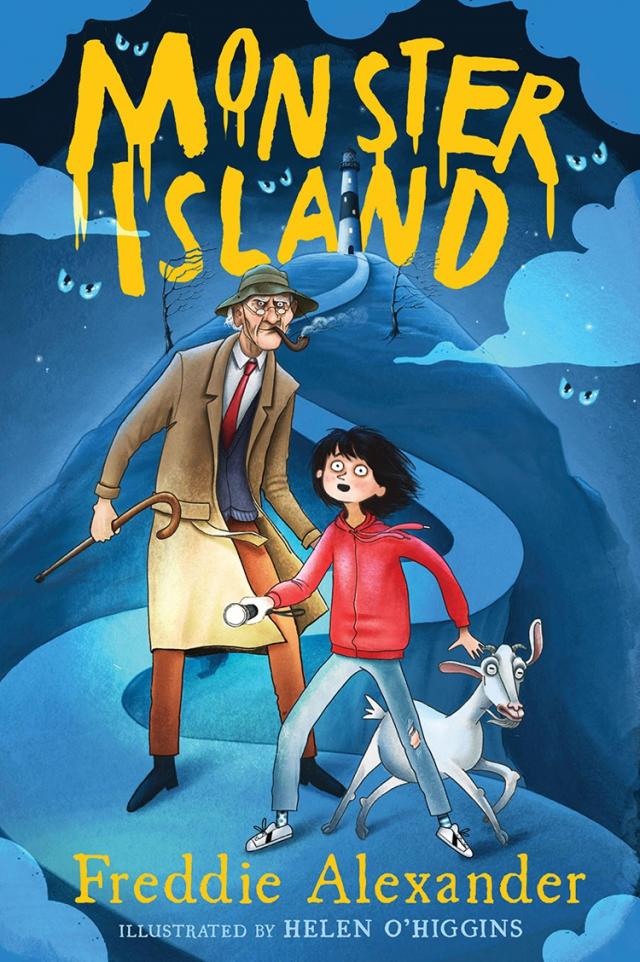


MONSTER ISLAND
by
Freddie Alexander
Illustrated by Helen O’Higgins
Copyright
HarperCollinsIreland
The Watermarque Building
Ringsend Road
Dublin DO4 K7N3
Ireland
a division of
HarperCollinsPublishers
1 London Bridge Street
London SE1 9GF
UK
www.harpercollins.co.uk
First published by HarperCollinsIreland in 2022
Copyright © Freddie Alexander 2022
Illustrations © Helen O’Higgins 2022
Cover design by Graham Thew © HarperCollinsPublishers Ltd 2022
Cover illustrations © Helen O’Higgins
Freddie Alexander asserts the moral right to be identified as the author of this work.
A catalogue copy of this book is available from the British Library.
This novel is entirely a work of fiction. The names, characters and incidents portrayed in it are the work of the author’s imagination. Any resemblance to actual persons, living or dead, events or localities is entirely coincidental.
All rights reserved under International and Pan-American Copyright Conventions. By payment of the required fees, you have been granted the non-exclusive, non-transferable right to access and read the text of this e-book on screen. No part of this text may be reproduced, transmitted, down-loaded, decompiled, reverse engineered, or stored in or introduced into any information storage and retrieval system, in any form or by any means, whether electronic or mechanical, now known or hereinafter invented, without the express written permission of HarperCollins.
Source ISBN: 9780008473150
Ebook Edition © September 2022 ISBN: 9780008473167
Version: 2022-08-09
Dedication
For Zelda and Rafe with love
Contents
Cover
Title Page
Copyright
Dedication
Chapter 1
Chapter 2
Chapter 3
Chapter 4
Chapter 5
Chapter 6
Chapter 7
Chapter 8
Chapter 9
Chapter 10
Chapter 11
Chapter 12
Chapter 13
Chapter 14
Chapter 15
Chapter 16
Chapter 17
Chapter 18
Chapter 19
Chapter 20
Acknowledgements
About the Author
About the Publisher
CHAPTER
1
First off, let’s get one thing clear.
Monsters under the bed are real.
Let me repeat.
MONSTERS UNDER THE BED ARE REAL.
Sing it in the streets and scream it from the rooftops for all to hear.
MONSTERS UNDER THE BED ARE REAL!
Very real.
You may have been told otherwise. You may even have been told that to believe in such nonsense is silly and childish; that such creatures are a figment of your imagination. Well, let me tell you, Reader, to ignore my warning would be a mistake. And here is why …
There is a world under the bed that is as real as yours or mine.
It is a world of magic, both good and bad (and whoever says that magic is not real is very foolish indeed).
It is a world so different to our own, yet so similar at the same time.
It is a world with good creatures and, most definitely, very bad creatures.
And before you ask, yes, I have had my head examined; no, I have not eaten or drunk anything funny; and yes, I am telling you the truth. Now hush up and listen.
You see, monsters under the bed love children.
Not in the same way that your mum, or your dad, or your granny, or your dog, or your cat, or your goldfish loves you. No, Reader. Not at all. These monsters love children like you love … a large slice of chocolate cake … or a huge bag of sweets … or a large raw onion …
Well, perhaps not a large raw onion.
That’s right, monsters under the bed love to eat children.
Now, before you start screaming in terror, you will be relieved to know that most of these monsters do not come from under your bed. Or your neighbour’s bed. Or your neighbour’s flower bed for that matter.
Most of these monsters come from a place which is quite a safe distance from your hands, and your fingers, and your feet, and your toes. Yes, in all likelihood, these creatures shall leave your toenails entirely untouched.
That is not to say that you are completely safe, Reader. So, as the old saying goes, ‘sit up and pay attention, just in case’.
Now, regrettably, these horrible creatures do not just eat children. No. As you will learn, there is a fate worse than being a starter, a main course and a dessert all at once.
And that is this (to be read in a whisper for added effect): There are some monsters that can sneak inside a child at night and take over that child’s body and mind. (Back to normal indoor voice, please. Thank you.)
I do not know why this is, Reader. There may be many reasons.
Perhaps they want to know what it is like to jump up and down on a bouncing castle at a birthday party. Or maybe they want to know what it is like to throw a paper aeroplane while a teacher is not looking. Or they might even want to know what it is like to pick a child’s nose.
I could guess and guess and guess all day long. Quite simply, I do not know why precisely they would want to possess a child, but they do.
Can you imagine the horror of it? Picture it. One of these creatures munching your cereal, eating your snot, being tucked into your bed and no one would be any the wiser. Not even your cat or your dog (and they know everything).
Another thing to know about these monsters is that they hate grown-ups.
Not hate in the same way that you hate, say, homework, or listening to some boring teacher drone on about what you must do for your homework, or watching a very (very) long documentary on the history of homework.
No, these monsters cannot stand the taste of grown-ups because they drink too much coffee and are filled with nothing but horrible thoughts like … making you eat your vegetables … or emptying the bins … or, ‘These telephone bills are too high; no more transatlantic calls to the president of Peru for you!’
In all seriousness, at this point I feel a DISCLAIMER to be appropriate. If you should find this story too scary, or if any grown-ups should find it too rude, then, by all means, please feel free to close this book and never open it again. Feed it to your goldfish with your leftovers if you like.
BUT …
If you want to learn more about these monsters, you should, nay, you must continue to read this story. For this, you will learn, is one with tips and tricks on how to deal with these grotesque and sneaky creatures on the tiniest of off chances that you ever come across one.
And if by the end of this book you are still with me in one piece, you might do me the favour of yelling for all to hear:
MONSTERS UNDER THE BED ARE REAL!
So, where to begin?
Well, first you’ll need to get nice and comfy. Oh, and before you read any further, just to be absolutely safe, I suggest that if you are in bed, please ensure that, like a rollercoaster, your arms and your legs are tucked in nice and tight under your sheets and well away from the edge of the bed. This way, I would fully expect that you shall not suffer any gruesome or grisly interruptions while reading this book.
Well, we’ll see.
Are you ready?
Excellent, let’s go!
CHAPTER
2
This story is set many, many years ago, long before you were even born, when I was just a wee lad. How wee, you ask? Well, I’m afraid it’s rude to ask grown-ups their age, so I suppose you’ll never know precisely.
Did electricity exist? Yes, just about. Did the internet exist? Only if you are asking about a strange type of fishing net. Were velvet blazers in fashion? Trick question: velvet blazers are always in fashion, Reader.
Our story begins with Sam Shipwright, an 11-year-old girl, who did not have much in common with the other girls in her school. In fact, she hated all things ‘girlie’.
She hated wearing dresses and loved fishing. She hated dolls and loved spitting. She enjoyed skipping, but only as part of her boxing training.
She was tall for her age and had thick, black hair which stopped just above her shoulders. She nearly always wore jeans, grubby runners and a trusted red hoodie.
Sam’s classmates considered her a strange child (although most people I know are a bit strange). Not that she was strange, rather she did not fit in with the crowd. You see, Sam answered to no one. She did not fall in with the popular girls and, in turn, with the rest of the pack. Sam kept herself to herself and she was just fine with that, thank you very much.
Sam’s parents too kept to themselves. And they too answered to no one. They never had guests over to their house. They never answered the telephone. And they never answered the front door (a good life lesson right there).
In many ways, Sam’s life was perfection. Just her, her mum and her dad.
It was a very sad event that turned her life upside down and inside out.
Sam’s world changed forever when she was informed of her parents’ tragic passing. It does not matter how it happened, Reader. I shall s
Sam had lived in Dublin, Ireland with her parents. Maybe I should have told you this earlier, but in my defence we are still very early on in this story. Plus you never asked, so let’s not argue and just move on.
Hers had been a wonderful home, there is no doubt about that. One with fancy red-brick houses and cobbled tree-lined streets. One with ponds for paddle boating and tucked away pubs for belly bloating. One with people named Bertram and Verity (you know the sort).
Sam had not known her grandad before her parents’ tragic deaths. She had never met him at all, in fact. For, you see, he lived on a remote island north-west of Dublin, north-west of Ireland and, Sam would soon discover, north-west of central heating.
The island was called Draymur Isle and, in more ways than one, it was a very inconvenient place to live indeed. To put it in perspective, Reader, if you can imagine the most inconvenient place you have ever been to in your life, this was most definitely north-west of that.
Sam’s first sight of Grandad was from the upstairs landing. He was just a tall silhouette standing in the front doorway. He wore a trench coat, a fishing hat and had a suitcase from the Stone Age. He carried a walking stick, using it every third step only.
From their very first meeting, Grandad took charge. He had a calm and gentle presence about him that immediately reassured and comforted her.
‘Everything will be okay, my dear,’ Grandad told her in his unusual accent. ‘You can rely on me fully to take care of you always.’
Sam needed no further convincing. She was exhausted and so deeply hurt that these words alone convinced her. She fell into his arms – this man, who was little more than a stranger – and they cried. There was no looking back; the pair were made for each other.
From his old photographs, it was clear that Grandad had once been a very handsome man, but he had all sorts wrong with him now; mainly a bad limp that he had picked up in ‘the war’ (although he had been vague about which war). He was weary in movement and looked older than he was. He wore shirts, never t-shirts, as is normal for men above a certain age. He always smoked a pipe and spluttered heartily if he laughed too hard.
Sam learned that Grandad had left school at the age of 12. While his classmates had been inside studying history, or maths, or science, Grandad – or Jacob, as he was called back then – was outside the school gates learning about animals, and birds, and bees, and trees, and sorts. He was self-taught in every which way and was a veteran of adventure, as well as war, having travelled far and wide.
After some weeks in the red brick house, Grandad felt it right for Sam to get away from it all. It was agreed that they would return to Grandad’s home on Draymur Isle. Sam put up little resistance because, in truth, she needed to be as far away from this dreaded reality as possible.
So, she packed her bags. She was sad to be leaving, but could not stay any longer.
Before she left, Sam went into her parents’ room and looked in her mother’s dresser. She found what she was looking for immediately: an old snow globe about the size of a tennis ball. She shook it and the globe lit up brightly. Inside stood a small lighthouse, no bigger than your thumb. The snowflakes swirled hypnotically, and her vision blurred with tears.
Sam carefully placed the snow globe into her bag pack, turned off her parents’ light and left the room for the last time.
CHAPTER
3
Very, very early the next morning, they set off on the long, long journey to Draymur Isle. It was so early in fact that it was still the night before. They had taken a taxi to a bus station, where they waited for a bus, which was of course late. The bus drove them at breathtaking speed to the very north-west edge of Ireland. From there they hopped on a boat that floated for many hours across an extremely rough and vomit-inducing sea.
It was very late when they arrived on Draymur Isle which was dark, and jagged, and cold. An unkeen ferryman tossed their suitcases onto a tiny harbour and hurried the pair off. He did not stick around to take in the view either.
‘Welcome to Draymur Isle,’ shouted Grandad above the wild weather, clasping his hat to his head for safe keeping.
The sea and the rain swept in from all angles and the two were sodden within seconds. Sam’s first impression was of a harsh and unfriendly place … and she was right to feel uneasy.
The two made their way up to Grandad’s home – a disused lighthouse, dangerously close to a cliff edge. Although she would never admit it, Sam felt nervous as she walked the dark and unsteady terrain towards her new home.
By all accounts, by which I mean, what Grandad had told Sam, the island was wildly unwelcoming for much of the year. It was often freezing and, while it was striking in its own way, it was very different to Dublin. No bright lights. No hustle and bustle. No frequent traffic jams. Hardly anyone ever came to Draymur Isle and people rarely left, so everybody knew everybody.
The lighthouse was more or less the same as it had been one hundred years earlier, except the great light was not used any more – there was no need, as boats tended to avoid the island and its ever-choppy waters altogether. There was no oven, so cooking normally took place in a heavy pot that hung over the fire. The toilet was in an outhouse next to the cliff which was, as you can imagine, Reader, unbearable during the winter months (and surprisingly pleasant during the summer months).
Grandad lived alone. Well, almost alone. He owned a whiter-than-white dairy goat named Myrtle. She was not a clever animal and spent most days eating plants, and shoes, and books, and really anything she could get her teeth on. She ate most of Grandad’s belongings. But on the upside, this meant that the lighthouse had a minimal feel and was always tidy.
On entering the lighthouse upon their arrival, Myrtle stared at Sam suspiciously.
‘Now, very slowly,’ instructed Grandad nervously, placing a small package into her hand, ‘set this cheese sandwich in front of Myrtle.’
Sam slowly placed the sandwich before the intimidating goat and bowed as Grandad had instructed on their walk from the ferry.
Myrtle considered the tinfoil-wrapped sandwich before her. She took one sniff and scoffed the sacrificial snack at an alarming speed. The goat bowed back at Sam.
Grandad let out a sigh of relief. The peace offering had been accepted and Myrtle took to Sam like a long-lost friend.
‘Myrtle, this is Sam,’ smiled Grandad, stroking the greedy goat’s beard. ‘She will be living with us from now on.’
This might all sound very strange, Reader, but Grandad’s caution was not without good reason. You see, Myrtle had a violent temper and did not like anybody on the island except for Grandad. In fact, anybody who came close to their lighthouse was quickly escorted from the property, by which I mean violently chased, sprinting and screaming, by the manic goat. Nobody on Draymur Isle crossed Myrtle.
While life on the island would take some getting used to, Sam enjoyed Grandad and Myrtle’s company from the start.
For one, it was immediately clear that Grandad was a fantastic storyteller. He had an aura about him that would make anyone sit up and listen. He had a unique accent and a voice that held a room’s attention, so it was impossible not to hang on his every word. English was not his first language, so he had an interesting way of speaking. He built great fires too – one inside for cooking, heating and bath water, and another outside for burning rubbish (global warming had not yet been discovered).
Late at night, Grandad cooked what he liked to call ‘Bedtime Supper’. Bedtime Supper commenced at around ten or eleven and usually consisted of a few sausages cooked in the heavy pot that hung over the fire. Instead of plates, they used bread, not only to avoid cleaning, but because Myrtle had eaten all the plates. This was thoroughly enjoyable and worth the late-night burping.
On Sam’s very first night in the lighthouse, before she had even unpacked, they settled in front of the fire for Bedtime Supper. After Sam and Grandad had finished their sausages, and Myrtle had finished Grandad’s slippers, Grandad stretched his heavy, worn legs and prepared his pipe. Sam stroked Myrtle’s beard and the greedy animal snored aggressively on the floor.









