

Better than we found it, p.1
Better Than We Found It, page 1
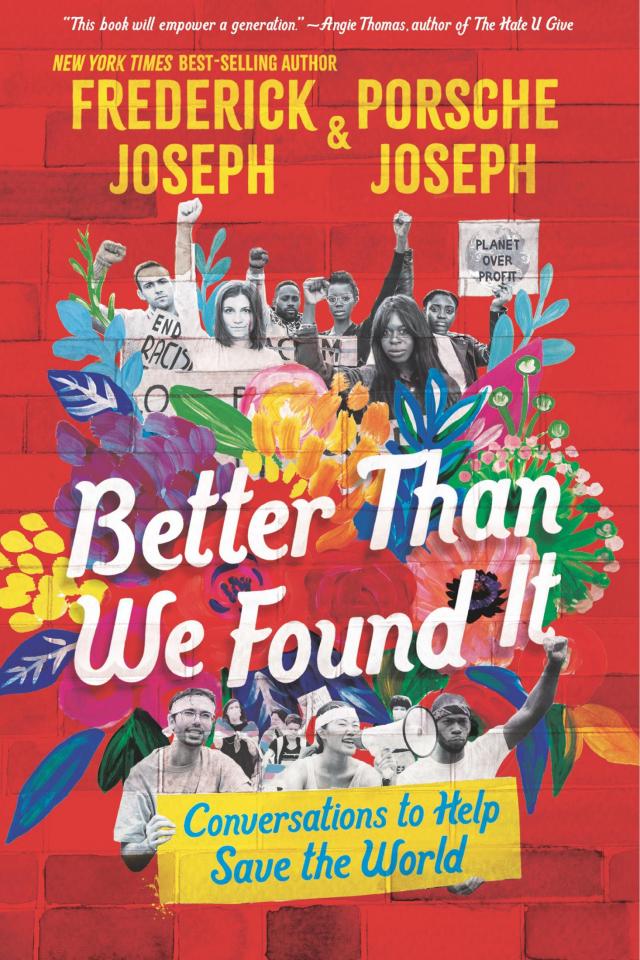


Foreword by Taylor Denise Richardson
Introduction: Together, We Can . . .
1: Not All Information Is Created Equal
The Dangers of Disinformation (featuring Chelsea Clinton and David Villalpando)
2: We’re the Planeteers; You Can Be One, Too
The Threat of the Climate Crisis and Environmental Racism (featuring Willy and Jo Lorenz and Mari Copeny)
3: Sledgehammers and Glass Ceilings
Being a Feminist and Womanist Accomplice (featuring Brittany Packnett Cunningham and Mehcad Brooks)
4: Let Them Eat Cake
The Damage Caused by the Wealth Gap (featuring Robert Reich)
5: We Shouldn’t Be Afraid to Leave Home
The Devastation of Gun Violence (featuring Shannon Watts and Brandon Wolf) (*trigger warning*)
6: You Can’t Discover a Place If People Are Already There
The Importance of Addressing Indigenous Land Theft (featuring Anton Treuer and Andrea Tulee)
7: Black Squares Don’t Save Lives
Consistently Practicing Anti-racism and (Re)Learning History (featuring Dr. Sonja Cherry-Paul)
8: The More You Know!
The Need for Education Reform (featuring Elizabeth Warren)
9: The Heteronormative Agenda
The Dangers and Ignorance of Homophobia (featuring Brandon T. Snider)
10: The Price of Life
The Importance of Health Care Reform (featuring Anna Paquin and Jesse Katz)
11: You, Me, Us, Them
Respecting Gender Identities (featuring Charlotte Clymer and Ben O’Keefe) (*trigger warning*)
12: Home Is Where the Rent Is (or Isn’t)
The Need for Housing Security (featuring Julián Castro)
13: We Have Money for War but Won’t Feed the Poor
Understanding the Military Industrial Complex (featuring Amed Khan)
14: America’s Modern Slavery
Dismantling the Prison-Industrial Complex (featuring Nic Stone)
15: Is Everyone Really Welcome?
The Dangers of Ableism (featuring Keah Brown, Natalie Weaver, and Greg D’Amato)
16: No Human Is Illegal
The Impact of Immigration Policy (featuring Daniel Alejandro Leon-Davis)
The End: We Can Be Heroes
On Seeing Each Other’s Humanity (featuring Frederick Joseph and Porsche Joseph)
The Dictionary of Change
Source Notes
Acknowledgments
Index
by Taylor Denise Richardson
Advocate, activist, speaker, student, and philanthropist
A person’s character is shaped largely by their experiences, and my generation, Gen Z, is astutely conscious that our experiences not only shape our identities but are also the reason we recognize the true, deep similarities in others—similarities that extend beyond race, ethnicity, gender, sexuality, and socioeconomic status. Gen Z has come of age in a time of tremendous upheaval. Whether it’s dealing with the effects of COVID-19, mass school shootings, or police brutality (either directly or through the media), we have experienced these events as a generation and have recognized the change that needs to occur in our society. Part of that change has meant unlearning many of our parents’ traditional views and redefining life for ourselves.
The common ground of shared experiences has given root to an empathy that allows our generation to feel and understand the inequalities perpetrated against one another in ways that were not common in previous generations. The internet and social media have been integrated into our lives since birth, which has facilitated this understanding, making it easy to find someone who has been down a similar path and wants to know that they are not alone. Digital communities and the ability of real-time information to spread widely is the reason our generation has the capability to learn, grow, and apply what we have learned. But with so much access to information about vital issues vying for our attention and resources, it can feel impossible to know where to turn, whom to trust, or how to help.
Better Than We Found It shines a spotlight on sixteen of the most pressing issues in today’s society. Each chapter breaks down a long-standing problem that is ripe for change by shining a light on the gray areas so that the black-and-white issues are there for all to see. This is vital if the goal of progress is going to be met, because ignorance and plausible deniability are two of the biggest roadblocks in the way of progression. Progress begins with accountability and the desire to fix the issues that appear in society without an immediate response of defensiveness. It is impossible to work toward a solution if we aren’t aware of the core issues and where they originated.
Through heart-moving stories and conversations with experts and activists, Better Than We Found It looks at problems from multiple angles and asks questions like: Whom does this problem affect? Why is the issue still prevalent? and What are people doing to ameliorate the situation? Each chapter taught me something new and aided me in better understanding who I am and who I want to be—as an activist, advocate and, most importantly, as a young Black woman.
One chapter that strongly resonated with me was chapter 3: “Sledgehammers and Glass Ceilings,” which is about being a feminist and womanist accomplice. It discusses how when sexism and the patriarchy work together in our society, a disservice is done to humankind because women are not celebrated for being their unapologetic selves due to stereotypical beliefs, misogynistic standards, and contrived barriers. For K Torch, it was gaslighting men telling her how she should look and act based on their limited vision of what successful female rappers looked like. For me, it was men telling me that I could never be an astronaut because it was a “boys’ game” and that engineering and the medical fields were “too difficult” for me to partake in. This is something I’ve heard since I was a nine-year-old girl at Space Camp. That’s why it is crucial for people, specifically men, to understand that gender roles and sexist beliefs were created to feed into the patriarchy and prohibit women from being in power and reaching their full potential. We have to remind girls and women that it’s not enough to break barriers, but that we must do everything in our power to eliminate them completely for the betterment of humankind. And to do so, we need men who fight alongside us, not against us.
This book is a great reminder for young readers to stay true to themselves, no matter what. But being true to yourself also means being truthful with yourself. We all need to recognize the pivotal roles our words and our ignorance play in the lives of those around us. Each chapter has not only widened my lens on issues I didn’t know all that much about, but has also touched my heart personally and reminded me why it’s paramount to continue to listen, learn, and grow. More than anything, this book made me want to do even more to make this world a better place for myself and others by aiding my generation of future leaders to listen and digest the stories of those impacted by these issues and by putting together tailored plans of actionable steps that lead to realistic solutions.
To my friends who are working on themselves and trying to grow: I hope that this book will help you learn from the mistakes of others so you can make better decisions and take away the excuse of being ignorant to the issues. I know it will provide you with comfort to know that there are people out there fighting for the issues we care about. I can say that I am now confident enough to go out into the world, be aware of the things I am experiencing, and correctly label them so that I can help others better understand me—and so that I can better understand others. This is something that I know our generation struggles with. Communication is hard, and clearly expressing one’s point of view can prove difficult when it’s wrapped in emotions. Better Than We Found It is a sophisticated GPS that will help readers be efficient on their world-saving journey and aid them in avoiding the dangers and pitfalls of being complacent. With that being said, I hope everyone who opens this book gains a new level of assurance in themselves and feels empowered to join in the fight to make our world one that is truly respectful, open-minded, and kind to all—to make the world indeed better.
Signed with love,
Taylor
Dear one,
Progress isn’t the longest word in the dictionary, but in many ways it’s the largest. Housed within its definition are words such as courage, hope, learning, and effort. But progress is more than just a word; it’s an ideal and a direction toward who and what we may become.
Progress by its very definition requires change, and unfortunately the concept of change is something deeply opposed by many people. There are those who find change intimidating or frightening, and there are also those who actively try to stop change because they benefit from things remaining the same.
But the truth is that change is necessary. The scourge of destructive forces such as racism, sexism, climate change, and gun violence have left the fabric of our society in tatters. Communities, families, cultures, individuals, and entire races have been devastated and even destroyed because of these forces.
And the devastation continues. Too many people are still suffering and far too much will be lost if we do not act.
Growing up, neither of us had the tools or resources necessary to combat or even understand many of the issues we discuss throughout the book. Which is why we wanted to give others what we wish we would have had sooner. What would Porsche’s life as a young biracial woman have been like if she hadn’t had to worry about her family being houseless when her apartment burned down or about how horribly her
While we each faced these traumas and hardships as individuals, we are part of a community of billions around the world who have faced similar experiences of poverty, violence, and prejudice. Understanding that the various challenges that exist in our society are all connected is the first step to eradicating these challenges.
We called upon this community when putting together this book. Like everyone, the two of us come from very specific backgrounds and have experiences that shaped who we are and what we say in this book. But we are aware that our perspectives can’t speak for everyone. There are communities we don’t belong to and experiences we don’t share—but at the center of progress is the ability to make space to learn from and be better for those unlike ourselves. Which is why we’ve made space for others to offer their knowledge and perspectives. The book features conversations with numerous thought leaders, activists, and experts to help create a deeper and more intersectional lens through which to view these vital topics.
SIDE NOTE: In the back of the book, we’ve added definitions for the words that are bolded throughout. We’ve also created an online toolkit focused on the topics discussed throughout the book, which includes additional resources and actionable steps to make change. Be sure to check out BetterThanWeFoundItBook.com.
When we began writing, we didn’t want to simply tell stories about the ways the world might have wronged us; we also wanted to provide an opportunity to see how all of us might be unknowingly wronging the world. No one is perfect, and there are many ways that the two of us have had to listen and learn. As much as this book is an opportunity to take action, it’s also an opportunity for growth. Because we’re all still learning.
In forging a path to a better world, stumbling is inevitable. Many of the struggles, missteps, and mistakes you will make, we have made as well—and we will all continue to make mistakes. But there should be grace for those who are willing to be held accountable when they stumble. A person is remembered for how they got up, not how they fell. What did they learn? How did they grow? Did they have the courage to be better the next time? Progress is a journey filled with imperfection; the important part is that you take the journey.
Our imperfections give us the opportunity to constantly strive for better. This book offers all of us that opportunity.
These pages are both a labor of love and a leap of faith. In them we offer our truths, our failures, and the ways in which we’ve grown, in hope that readers will feel not only inspired—but loved.
Love for others is fundamental to the work we’re doing. In so many ways, we are all family, connected by our pain and our joy. In the stories and conversations throughout this book, we have tried to help people understand these connections and the importance of considering why even a stranger should be dear to you.
We hope that even if some, many, or most of the experiences relayed in this book do not resonate for you firsthand, the stories and interviews still serve to create the building blocks of empathy that will inspire you to take action. Our greatest desire is that you will choose to use whatever privilege you may have to understand and protect others, and that others will do the same for you in spaces where you lack privilege.
For the sake of the dear ones in our lives and for the sake of the children we hope to have one day and the people they will consider dear ones, we’ve challenged ourselves to give more to this world than we take, and we are challenging you to do the same. More thoughtfulness, more acceptance, more respect—and more love.
Progress is possible—if we lean into the bravery and leadership it will take to create it. This book is our attempt to do that. With it, we hope to shed light on some of the most critical issues we face as a society and inspire you to create necessary change—inspire you to be brave along with us and to lead alongside us, and alongside the millions of others already growing and taking action.
Better Than We Found It isn’t just a title; it’s the manifestation of our wildest dream: that future generations won’t have to face the challenges we are facing. The world is changing quickly, no matter how much some may try to avoid or even prevent it, and together we will decide in what direction it goes. All of us are the youth of yesterday and the ancestors of tomorrow. As such, let us be remembered for progress, let us be remembered for saying “enough is enough,” and let us be remembered as leaders who saw the greatest issues and challenges of our time and chose to boldly overcome them.
Because having a vision for what the world should be means nothing if you won’t do what’s necessary to create a world in that image.
With love,
The Josephs
A NOTE ON THE ANECDOTES: While we strove to make these scenes as accurate to reality as possible, the dialogue has been re-created from memory, which means it's a representation of what happened and not a literal transcript of what was said. Names, too, have largely been fictionalized.
Frederick Joseph on the Dangers of Disinformation
Featuring Chelsea Clinton and David Villalpando
Have you ever known someone who believed something that was factually, provably incorrect, yet they refused to accept that they were wrong because their information came from a trusted source? I’m sure many of us have experienced this particular frustrating scenario at one point or another. What we might not have realized is that those people may have been victims of someone’s plan to purposely spread false information.
Throughout history there have been people with a vested interest in ensuring that others believe things that are untrue. From political rivals spreading lies about one another in order to sway voters to a classmate taking credit for someone else’s work, lying has been around for a long time. While lying might not be new, many of the tools, strategies, and goals are.
As I was working on this chapter, I read an article about a company based in London that was attempting to pay social media influencers from around the world to post false information about one of the COVID-19 vaccines. While many of those influencers didn’t post the false information, a few from Brazil and India apparently did. When attempts were made to research the company, it was found that there was no company existing at the London address given and that the content on the company’s social media accounts had been completely deleted.
What this company was asking those influencers to spread is called disinformation, which is false information that is deliberately spread to deceive people. (This is different from misinformation, which is false information as well, but not deliberately so.) There could be many reasons why they were purposely trying to spread lies—for example, perhaps they were attempting to undermine one company’s vaccine in favor of another’s—but what matters is that during a global pandemic, they were attempting to make people afraid of a vaccine that is saving lives. One person spreading lies about a vaccine could become millions of people believing those lies and refusing to get that particular vaccination.
Understanding the importance of combating false information with the truth is essential to the fight for progress. It’s why we chose to make this the first chapter of the book—and in many ways it’s the reason we needed to write the book in the first place. There are people invested in spreading lies that are damaging the world, and so there must also be people invested in spreading the truths that will help save it.
When I was growing up, I often heard the saying “Truth is in the eye of the beholder,” which I felt essentially meant that as individuals we decide what is true and what is not based on our own opinions and experiences. I was much older when I realized how problematic that idea could potentially be.
While it’s important to understand that people may have different perspectives, there are certain things that are simply true and others that are untrue. For example, there are millions of people who believe that climate change is a hoax—something purposefully made up to look like the truth—and others who think the impact of it is exaggerated, even though countless scientists and governments around the world have said otherwise and the effects of climate change are devastating the world as you read this. These people are often referred to as “climate deniers” (something Porsche delves further into within the next chapter). Though they are endangering others and holding back needed progress, if we want to change their actions or the results their actions have on others, it’s important to understand how and why people such as climate deniers believe what they do.






