

Suddenly a corpse, p.1
Suddenly a Corpse, page 1


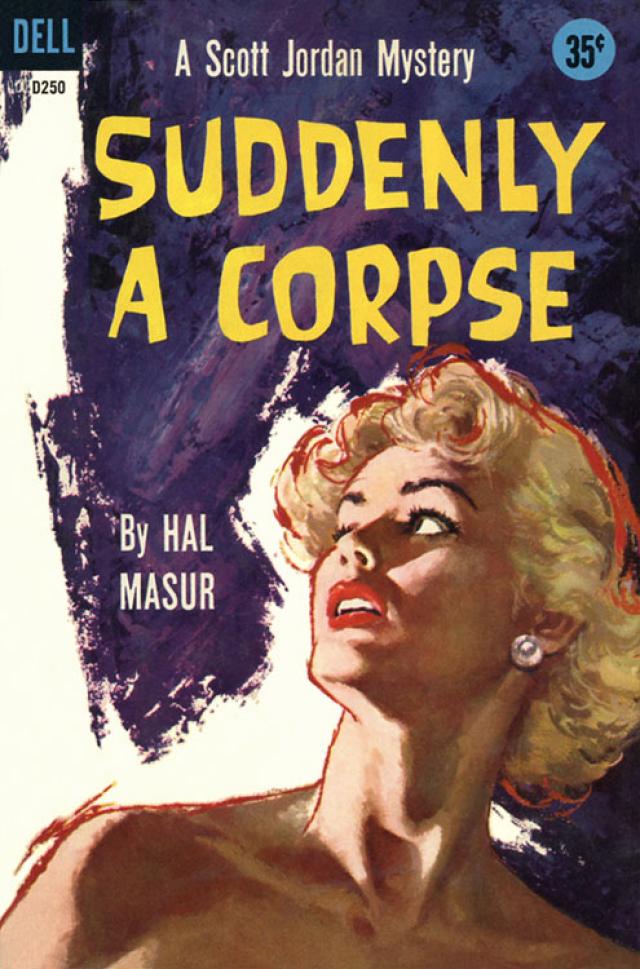
Hal Masur
SUDDENLY
A CORPSE
A DELL MYSTERY
CHAPTER ONE
Trouble came to my door on Wednesday evening when the fat man with the frightened eyes entered my life and simultaneously departed from his own.
I was home minding my own business, engrossed at the moment in two hobbies, listening to Beethoven’s Eroica, and handicapping the horses for tomorrow’s meeting at Jamaica.
This was to be an evening of solitude, so I was both surprised and annoyed when the doorbell rang. I looked up; the hands on the clock semaphored nine-thirty. I didn’t move because I was expecting no one and there was no one I wanted to see. But the bell kept ringing with a kind of hysterical insistence, as if the button had got jammed.
I sighed, arose, went to the door, scowled, and pulled it open.
The fat man looked terrible. He was in distress. His eyes were feverish in a flaccid face the color of overboiled milk. He stood there breathing in great, labored gasps through a mouth pulled back over square teeth.
“Jordan?” he asked, in a voice that was a stretched whisper of agony.
“Yes,” I said, startled.
He leaned toward me and I jumped back in alarm. His face was slippery with sweat and veins forked redly through his eyes. I never thought of slamming the door against his nose. As I moved backward into the apartment he followed me, weaving unsteadily, like a drunk on a new pair of artificial legs. Each step put another twist on his mouth.
“Look, mister,” I said, “what do you want?”
He worked his mouth for a moment, soundlessly. Then his hand groped up and clawed his collar open and he croaked, “Be… careful…” in a bubbling voice, and the froth that had trickled between his lips turned red.
He fell.
His body simply caved, slowly, with the boneless movement of a crushed caterpillar. He crumpled to the floor, face first, one hand outstretched. I looked down and saw the hole in his back, dead center, between the shoulder blades. It was still leaking.
For a moment I just stood there. I couldn’t move. Then I reached automatically for the man’s pulse. There was no pulse.
He was dead.
I kept staring at him, dumbfounded. I’m no stranger to death. A corpse is nothing new to me. I belong to a generation that has seen lots of corpses. That’s what wars are for—to make men dead, untidily, and in abundant quantities.
But a single corpse suddenly dead on my living-room carpet was something else.
Moreover, a total stranger, a man I didn’t know from a hitching post. But one who certainly knew my name and obviously had been trying to warn me of something.
It was ironical. I had just been congratulating myself on the opportunity for spending a quiet evening at home, free from the problems of a growing law practice, relaxing in a peacefulness that was doubly welcome after all the unsavory violence of the Cambreau case.
Suddenly I was blinking at my Capehart. The Eroica had entered its second movement. Somber, gloomy funeral music swelled out in a kind of mournful dirge for the dead man on the floor. I went over and shut it off, unconsciously stroking the instrument, which had been a prodigal extravagance. The down payment alone had nicked me for a month’s income with the balance due over several backbreaking years.
No more music and no more doping the ponies for tonight. I folded the scratch sheet into my pocket and went back to the corpse.
Surveyed from any angle it was trouble. The hard-hat boys would be full of questions and I had no supply of answers. They wouldn’t like that, which left me up the creek. There had been a time when I might have played it different, when I might have hauled the body up a flight of stairs and left it camped around a bend in the corridor for somebody else to find.
Not now. Now I had too much respect for the lab boys, for their ability to ferret out episodes in the career of a corpse before its introduction to the police. Fiddling with a cadaver is something the homicide boys do not appreciate.
So I knew what I had to do. I got on the telephone and called headquarters. “Lieutenant John Nola,” I said. They put me through. “John, this is Scott Jordan.”
“Well, hello, counselor.” He sounded genuinely pleased. “Long time no see.”
“I need you, John.”
He detected the note of urgency in my voice. “Trouble?”
“Yes.”
“I’ll wait in my office,” he said crisply. “Come right down.”
“Can’t,” I told him. “The trouble is here, in my apartment.”
Nola was not a man to waste time on conversation when action was indicated. “Ten minutes,” he said, and clicked off.
I walked around the fat man to the small portable bar and broke open a fresh bottle of bourbon. I am not a drinking man, but sometimes it helps. My two and a half rooms at the Drummond had always seemed adequate. Now, however, with my guest lying speechless, it was likely to give me claustrophobia. I had a drink and wondered what the guy had been trying to warn me about. All of my current cases were placid litigations, confined to the civil courts, the kind of stuff in which I was trying to specialize. Nothing that should lead to violence—or murder.
I was trying my luck on the third bourbon when the bell summoned me to the door. John Nola, wearing a prudent smile and searching my face sharply, put out his hand. I like the Lieutenant and I think the Lieutenant likes me, but I should have given him some warning.
He entered, spied the fat man, stopped short, stiffened his back, and stored his smile in moth balls. His eyes veered around and met mine in a hard, level stare.
“Who is he, Scott?”
“Don’t know. Never saw him before.”
“You shoot him?”
“No.”
“Okay. I’m listening. Open the bag and dump it.”
I recited and he listened. He stood with his feet apart, a neat, slender, sober man with a dark, intelligent face, alert as a squirrel and tougher than yesterday’s egg stains, inflexible and incorruptible, a career cop who’d pulled himself up from the ranks and danced at the end of nobody’s string. A cop all the way through, but a man with a heart, and a man you could respect. He’d seen me through the Cambreau mess and I knew where I stood with him.
There wasn’t much to tell. When I finished he said, “You never saw him before?”
“Never.”
“Yet he spoke your name.”
“That’s right.”
“And told you to be careful.”
“Yes.”
“Any idea what he meant?”
“None, Lieutenant.”
His eyes measured me, squinting. “Straight stuff?”
“On the level,” I maintained.
He bent over the body, explored, and straightened with a long flat billfold in his hand. He spent the next few moments studying the contents. Then he looked at me. “Does the name Victor Grove ring any bell?”
“Not in my memory.”
Nola seemed skeptical. “Sure?”
“Positive. What’s his racket?”
“Detective, private, working out of New Orleans.”
“Well,” I said. “How do you like that!”
He regarded me impassively for a long moment. “I hope to God you know what you’re doing, son. I’d hate to think you were trying to pull a fast one on me.”
I looked at him, aggrieved. “You know me better than that, Lieutenant.”
He sighed and said, “Okay, let’s have the squad in,” and unbent his elbow at the telephone.
The next hour was feverish with activity.
A battery of technicians invaded the apartment. They left exploded flash bulbs, chalk marks, dusting powder, cigarette stubs, and a pall of stale smoke. A man from the Medical Examiner’s office had briefly inspected the remains and offered it as his tentative opinion that a .32-caliber handarm had been the lethal weapon. He scribbled a DOA form and released the body to the boys with the canvas shroud. Not very neat, but all of it very efficient.
I sat in my bedroom with an assistant District Attorney. His name was Ed Magowan and he was an earnest young specimen in a Brooks Brothers’ suit, with crew-cut hair and a Harvard accent. I could tell from his manner that he wasn’t buying a word of my story.
A plainclothes man popped his head through the door and addressed Nola. “He’s here, Lieutenant.”
“Who?”
“The D.A.”
I groaned. And not without reason. I had tangled before with the Honorable Philip Lohman, District Attorney of New York County, and there was little love lost between us. He came in, a tall, smugly confident man with rimless pince-nez clamped on a high-boned nose that hung over a thin, humorless mouth penciled into a stiffly austere face. A pompous man who obviously held himself in high esteem. Erect as if he’d been starched and ironed out only ten minutes before.
Lohman had once been a good corporation lawyer, but as a public prosecutor his ambition far exceeded his skill. He had his sights trained on the Governor’s mansion in Albany. Luckily for the taxpayers, he had retained a number of capable men from the previous administration.
He ignored me, nodded briefly at Nola, and spoke to his assistant. “All right, Magowan, the facts?”
Magowan gave it to him, direct and to the point, with the accent on skepticism.
Lohman swung around and took me in irritably. “That’s your story, is it, Jordan? A man dies in your apartment, shot in the back, and you know nothing about him.”
“That’s right.”
I shrugged indifferently. “It’s immaterial to me if you do or you don’t.”
His eyes and mouth tightened. “You may change your mind about that before we’re through with you. Let’s hear you tell it.”
“I’ve already told it ten times.”
“Tell it again.”
I caught the flickering warning from Nola’s eyes. I sighed deeply and said, “All right, here it is. My bell rang. I went to the door. Grove was standing there. He spoke my name, stumbled into the apartment, croaked something about being careful, and fell down dead. I never saw the guy before in my life. I don’t know who he is. I have no idea what he was talking about.”
“Incredible.”
Nola injected himself quietly. “Most of Jordan’s story seems to check.”
“That so?” Lohman launched an eyebrow at him. “In what way, Lieutenant?”
“We know that Grove was shot in the hall outside. His fingerprints are staggered along the corridor walls, as if he was supporting himself trying to reach this apartment.”
“Any bloodstains out there?”
“A few. They’re being tested now.”
Lohman, scarcely satisfied, switched back to me. “Even so, you’re asking us to believe that this man, wounded as he was, had the fortitude to negotiate the corridor and walk halfway across your living room, yet he was totally incapable of further speech.”
“That’s right.”
“Despite unbearable pain.”
“Pain?” I said. “It only hurt him when he laughed.”
“None of your wisecracks,” Lohman snapped acidly.
I was beginning to burn. “I don’t like your implication that I’m lying.”
“If you’re not lying, you’re certainly withholding vital information.”
“That so?” I grinned insolently. “Then why not beat it out of me with a rubber hose?”
“We don’t work that way in this county.”
“Look,” I said wearily, “we’re getting nowhere fast. I’m tired. I’d like to clear out of this place and go to bed.” I turned to Magowan. “If we’re going to be here all night, you’d better write down some intelligent questions for him to ask.”
Magowan flushed angrily. He clicked his jaw and said, “I don’t like your manner, Jordan. So long as you’re involved in a homicide investigation you’ll co-operate with the District Attorney’s office, and you’ll display proper respect for Mr. Lohman.”
“Why?” I retorted sweetly. “Because a bunch of fat stomachs got together in a smoke-filled room and hand-picked a pair of bums for public office and then told the voters, see, this is a democracy, take your choice? Respect? Don’t make me laugh.”
That was putting it roughly and it was hardly a speech Lohman could enjoy. His face got dyed ox-blood and for a brief moment anger rendered him speechless. Magowan, displaying loyalty, moved toward me with a truculently jutting chin.
“Hold it!” The bark came from Nola and the ring of authority in his voice clamped Magowan’s brakes. Then Nola looked at me. “Get the chip off your shoulder, Jordan.”
“Sure,” I said. “Only let them stop trying to harpoon me. I’m not lying. They’ve got to cross that off before we can move in the same direction. I don’t like murder. I don’t like people dying in my apartment. I want to see this thing solved. Your department has the facilities for solving it. Okay. I want to help. Only let’s not start off on the premise that I’m trying to pull a fast one.”
Lohman had found his voice. “How hard you’re going to fall some day, Jordan!”
I let it slide so he could have time to cool off.
He turned gruffly to the Lieutenant. “How come nobody heard the shot?”
“The gun was probably equipped with a silencer. Probably that’s the reason only a single bullet was fired.”
“What do you mean?”
“The use of a silencer jams the pistol’s action. One shot and the weapon has to be reloaded. That takes time and killers don’t like to hang around.”
“The elevator man see anybody besides Grove?”
“He goes off duty at eight, when the car becomes self-operated.”
I had a thought and I said, “Why not contact Grove’s office in New Orleans? That ought to give you a lead.”
“It’s already been done,” Nola said in a tone implying that he hadn’t learned about detecting from a correspondence course.
“We don’t need your advice,” Lohman put in sarcastically.
“Let’s hold him as a material witness,” Magowan said, still steamed. “A night in the cooler might teach him a little respect.”
I laughed shortly. “Who are you kidding? I’m no hoodlum tagged robbing a candy store. Book me and I’d be sprung in an hour.”
“Cut it out,” warned Nola.
“Sure,” I said. “Just keep this clown out of my hair. He’s a nice-looking lad, but he rides his job too hard.”
Color stained Magowan’s cheeks. Nola stepped quickly between us, ready for trouble.
“Let’s call it a night,” he said. There was an uncompromising cast to his jaw. “We’re all tired, on edge. We’re accomplishing nothing.”
Lohman agreed with him. He stared at me hard, then turned on his heel and strode to the door, swinging his chin around for a parting shot. “You’re not out of the woods yet, Jordan, and don’t you forget it.”
A frustrated, exasperated Magowan gave me a blue glare and followed him out.
Nola sank into a chair and looked at me sidelong, shaking his head sadly. “You have a remarkable talent for pouring salt into a guy’s wound, my friend.”
“He irritated me,” I said.
“He irritated you!”
“Lohman’s always trying to usurp your functions. It’s your job to investigate; it’s his job to prosecute.”
“That’s not true.”
I knew it wasn’t and I said, “The hell with him.”
“He’ll be after your hide, Scott.”
“He can’t afford to hurt anybody. A new election’s coming up and there’s going to be a turnover in local politics. He’ll do his walking softly until he’s sure which way the wind is blowing.”
“I hope so. For your sake.”
“Don’t worry about me. Shot of bourbon?”
“Not when I’m working.”
“You’re not working. You’re through for the day.”
I poured and he accepted the glass. He sampled the drink, then drained it. His eyes, fastened on mine, were sober. “Let’s get one thing straight, son. I think you’re telling the truth. Maybe you knew Grove and maybe you didn’t. Pitch one ball with a fancy curve on it and you’ll think the City Hall fell on you. Am I clear?”
I nodded.
“Okay,” he said. “We’re working on the New Orleans angle. That ought to be good for a bounce in the right direction.”
I nodded. “Look, since Grove came from out of town he was probably staying in some hotel here. Why not check on it? His luggage ought to yield some clue.”
He smiled dimly. “Two men are working on that angle right now.”
“Full of ideas,” I said glumly. “Worn-out, secondhand ideas.”
“You’re tired, that’s all.”
He was being magnanimous. “No keys in his pocket?” I asked.
Nola shook his head. “Only a suitcase key. There’s a heavy tag on most hotel keys and people prefer to leave them in the box.”
“Maybe he just arrived in town and came straight to see me.”
“I doubt it.”
“Why?”
“Because he’d have checked his bag somewhere and we’d have the stub.”
“Unless he was bumped for it,” I said, “and the killer picked his pocket.”
Nola was morose, considering the idea and not liking it. If I’d hit the truth, then Grove’s bag would be gone by the time he caught up with the man’s hotel. He stood up, putting one of his thin dappled cigars between his teeth. He drifted around the room and finally wound up with his hand on the doorknob. He looked as tired as I felt.
“Stick around,” he said, opening the door.
“Sure.”
When he was gone I picked up cigarette stubs and opened all the windows, flushing air through the apartment. I didn’t do anything about the chalk marks that outlined the position where Victor Grove’s body had been.
They stuck in my mind all night.






