

Starry messenger, p.1
Starry Messenger, page 1


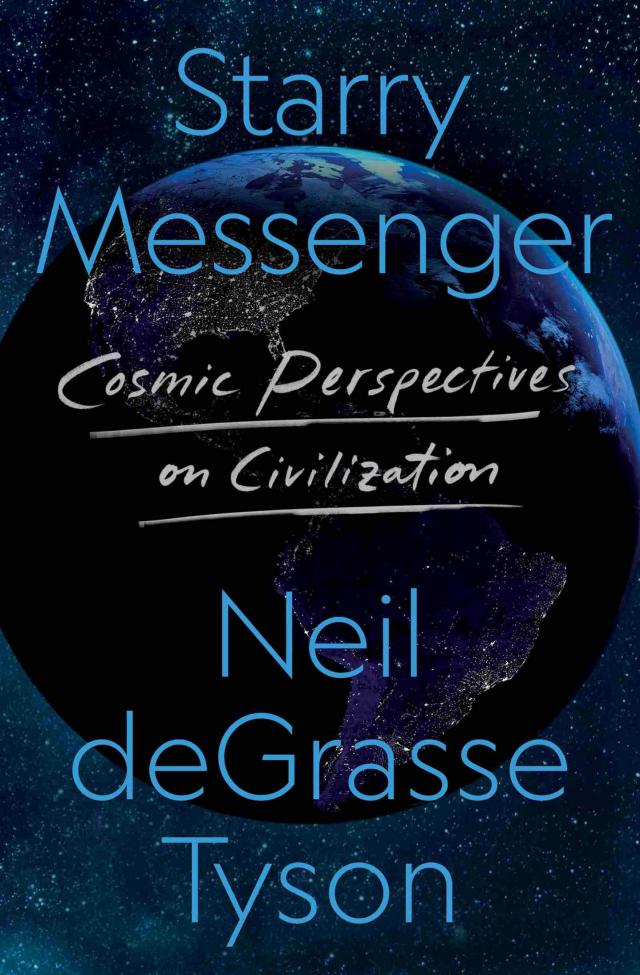
Begin Reading
Table of Contents
About the Author
Copyright Page
Thank you for buying this
Henry Holt and Company ebook.
To receive special offers, bonus content,
and info on new releases and other great reads,
sign up for our newsletters.
Or visit us online at
us.macmillan.com/newslettersignup
For email updates on the author, click here.
The author and publisher have provided this e-book to you for your personal use only. You may not make this e-book publicly available in any way. Copyright infringement is against the law. If you believe the copy of this e-book you are reading infringes on the author’s copyright, please notify the publisher at: us.macmillanusa.com/piracy.
Dedicated to the memory of Cyril DeGrasse Tyson1
and all others who want to see the world
as it could be, rather than as it is.
You develop an instant global consciousness, a people orientation, an intense dissatisfaction with the state of the world, and a compulsion to do something about it.
From out there on the Moon, international politics look so petty. You want to grab a politician by the scruff of the neck and drag him a quarter of a million miles out and say,
“Look at that, you son of a bitch.”
—Edgar D. Mitchell, Apollo 14 astronaut
PREFACE
Starry Messenger is a wake-up call to civilization. People no longer know who or what to trust. We sow hatred of others fueled by what we think is true, or what we want to be true, without regard to what is true. Cultural and political factions battle for the souls of communities and of nations. We’ve lost all sight of what distinguishes facts from opinions. We’re quick with acts of aggression and slow with acts of kindness.
When Galileo Galilei published Sidereus Nuncius in 1610, he brought to Earth cosmic truths that had been waiting since antiquity to descend upon human thought. Galileo’s freshly perfected telescope revealed a universe unlike anything people presumed to be true. Unlike anything people wanted to be true. Unlike anything people dared say was true. Sidereus Nuncius contained his observations of the Sun, Moon, and stars, as well as the planets and the Milky Way. Two fast takeaways from his book: (1) human eyes alone are insufficient to reveal fundamental truths about the operations of nature, (2) Earth is not the center of all motion. It orbits the Sun as just one among the other known planets.
Sidereus Nuncius translates from the Latin to Starry Messenger.
These first-ever cosmic perspectives in our world were ego checks on our self-importance—messages from the stars forcing people to rethink our relationships to one another, to Earth, and to the cosmos. We otherwise risk believing the world revolves around us and our opinions. As an antidote, Starry Messenger offers ways to allocate our emotional and intellectual energies that reconcile with the biology, chemistry, and physics of the known universe. Starry Messenger recasts some of the most discussed and debated topics of our times—war, politics, religion, truth, beauty, gender, race, each an artificial battlefield on the landscape of life—and returns them to the reader in ways that foster accountability and wisdom in the service of civilization. I also intermittently explore how we might appear to space aliens who arrive on Earth with no preconceived notions of who or what we are—or how we should be. They serve as impartial observers of our mysterious ways, as they highlight inconsistencies, hypocrisies, and occasional idiocies in our lives.
Think of Starry Messenger as a trove of insights, informed by the universe and brought to you by the methods and tools of science.
OVERTURE
SCIENCE & SOCIETY
When people disagree in our complex world of politics, religion, and culture, the causes are simple, even if the resolutions are not. We all wield different portfolios of knowledge. We possess different values, different priorities, and different understandings of all that unfolds around us. We see the world differently from one another, and by doing so, we construct tribes based on who looks like us, who prays to the same gods as we do, and who shares our moral code. Given the longtime Paleolithic isolation within our species, perhaps we should not be surprised by what evolution has wrought. Groupthink, even when it defies rational analysis, may have conferred survival advantages to our ancestors.1
If we instead back away from all that divides us, you might find common, unifying perspectives on the world. If so, watch where you step. That new vista is neither north nor south nor east nor west of where you stand. In fact, the place exists nowhere on the compass rose. One must ascend from Earth’s surface to get there—to see Earth, and everybody on it, in a way that leaves you immune to provincial interpretations of the world. We speak of this transformation as the “overview effect,” commonly experienced by astronauts who have orbited Earth. Add to this the discoveries of modern astrophysics as well as the math, science, and technology that birthed space exploration, and yes, a cosmic perspective is literally above it all.
Nearly every thought, every opinion, and every outlook I formulate on world affairs has been touched—informed and enlightened—by knowledge of our place on Earth and of our place in the universe. Far from being a cold, feelingless enterprise, there is, perhaps, nothing more human than the methods, tools, and discoveries of science. They shape modern civilization. What is civilization, if not what humans have built for themselves as a means to transcend primal urges and as a landscape on which to live, work, and play.
What then of our collective and persistent disagreements? All I can promise is that whatever opinions you currently hold, an infusion of science and rational thinking can render them deeper and more informed than ever before. This path can also expose any unfounded perspectives or unjustified emotions you may carry.
One can’t realistically expect people to argue in the same way scientists do among themselves. That’s because scientists are not in search of each other’s opinions. We’re in search of each other’s data. Even when arguing opinions, you may be surprised how potent a rational perspective can be. When illuminated by it, you fast discover that Earth supports not many tribes, but only one—the human tribe. That’s when many disagreements soften, while others simply evaporate, leaving you with nothing to argue about in the first place.
Science distinguishes itself from all other branches of human pursuit by its power to probe and understand the behavior of nature on a level that allows us to predict with accuracy, if not control, the outcomes of events in the natural world. Scientific discovery often carries the power to broaden and deepen perspectives on all things. Science especially enhances our health, wealth, and security, which are greater today for more people on Earth than at any other time in human history.
The scientific method, which underpins these achievements, is often conveyed with formal terms that reference induction, deduction, hypothesis, and experiment. But it can be summarized in one sentence, which is all about objectivity:
Do whatever it takes to avoid fooling yourself into believing that something is true when it is false, or that something is false when it is true.
This approach to knowing enjoys taproots in the eleventh century, as expressed by the Arabic scholar Ibn al-Haytham (AD 965–1040), also known as Alhazen. In particular, he cautioned the scientist against bias: “He should also suspect himself as he performs his critical examination of it, so that he may avoid falling into either prejudice or leniency.”2 Centuries later, during the European Renaissance, Leonardo da Vinci would be in full agreement: “The greatest deception men suffer is from their own opinion.”3 By the seventeenth century, shortly after the near-simultaneous inventions of both the microscope and the telescope, the scientific method would fully bloom, propelled by the work of astronomer Galileo and philosopher Sir Francis Bacon (Lord Verulam). In short, conduct experiments to test your hypothesis and allocate your confidence in proportion to the strength of your evidence.
Since then, we would further learn not to claim knowledge of a newly discovered truth until a majority of researchers obtain results consistent with one another. This code of conduct carries remarkable consequences. There’s no law against publishing wrong or biased results. But the cost to you for doing so is high. If your research is checked by colleagues, and nobody can duplicate your findings, the integrity of your future research will be held suspect. If you commit outright fraud—if you knowingly fake data—and subsequent researchers on the subject uncover this, the revelation will end your career.
This internal, self-regulating system within science may be unique among professions, and it does not require the public or the press or politicians to make it work. Watching the machinery operate may nonetheless fascinate you. Just observe the flow of research papers that grace the pages of peer-reviewed scientific journals. This breeding ground of discovery is also, on occasion, a battlefield of scientific controversy. But if you handpick pre-consensus scientific research to serve cultural, economic, religious, or political objectives, you undermine the foundations of an informed democracy.
Not only that, conformity in science is anathema to progress. The persistent accusations that we take comfort in agreeing with one another come from those who have never attended scientific conferences. Think of such gatherings as “open season” on anybody’s ideas being presented, no matter their seniority. That’s good for the field. The successful ideas survive scrutiny. The bad ideas get discarded. Conformity is also laughable to scientists a
* * *
In 1660, a mere eighteen years after Galileo’s death, the Royal Society of London was founded, and is still going strong as the world’s oldest independent scientific academy. Newly advanced scientific ideas have been contested there ever since, inspired by its marvelously blunt motto, “Take nobody’s word for it.” In 1743, Benjamin Franklin founded the American Philosophical Society to promote “useful knowledge.” They continue today in precisely that capacity, with members representing all fields of academic pursuit in both the sciences and humanities. And in 1863, a year when he clearly had more pressing matters at hand, Abraham Lincoln—the first Republican US president—signed into existence the National Academy of Sciences (NAS), based on an act of Congress. This august body would provide independent advice to the nation, founded in living memory, on matters relating to science and technology.
Into the twentieth century, a proliferation of agencies with scientific missions serves a similar purpose. In the US, these include the National Academy of Engineering (NAE); the National Academy of Medicine (NAM); the National Science Foundation (NSF); and the National Institutes of Health (NIH). It also includes the National Aeronautics and Space Administration (NASA), which explores space and aeronautics; the National Institute of Standards and Technology (NIST), which explores the foundations of scientific measurement, on which all other measurements are based; the Department of Energy (DOE), which explores energy in all usable and useful forms; and the National Oceanic and Atmospheric Administration (NOAA), which explores Earth’s weather and climate, and how they may impact commerce.
These centers of research, as well as other trusted sources of published science, can empower politicians in ways that lead to enlightened and informed governance. This won’t happen until the people who vote, and the people they vote for, come to understand how and why science works. Scientific achievement among a nation’s institutions of research constitutes the seedbed of that nation’s future and is nourished by the breadth and depth of support the agencies may receive from the administrative bodies that govern them.
After thinking deeply about how a scientist views the world, about what Earth looks like from space, and about the magnitude of cosmic age and of infinite space, all terrestrial thoughts change. Your brain recalibrates life’s priorities and reassesses the actions one might take in response. No outlook on culture, society, or civilization remains untouched. In that state of mind, the world looks different. You are transported.
You experience life through the lens of a cosmic perspective.
ONE
TRUTH & BEAUTY
Aesthetics in life and in the cosmos
Since antiquity, the subjects of truth and beauty have occupied the thoughts of our deepest thinkers—especially the minds of philosophers and theologians and the occasional poet such as John Keats, who observes within his 1819 poem “Ode on a Grecian Urn”:1
Beauty is truth, truth beauty,—that is all
What might these subjects look like to visiting aliens who have crossed the Galaxy to visit us? They will have none of our biases. None of our preferences. None of our preconceived notions. They would offer a fresh look at what we value as humans. They might even notice that the very concept of truth on Earth is fraught with conflicting ideologies, in desperate need of scientific objectivity.
Endowed by methods and tools of inquiry refined over the centuries, scientists may be the exclusive discoverers of what is objectively true in the universe. Objective truths apply to all people, places, and things, as well as all animals, vegetables, and minerals. Some of these truths apply across all of space and time. They are true even when you don’t believe in them.
Objective truths don’t come from any seated authority, nor from any single research paper. The press, in an attempt to break a story, may mislead the public’s awareness of how science works by headlining a just-published scientific paper as the truth, perhaps also touting the academic pedigrees of the authors. When drawn from the frontier of thought, the truth still churns. Research can wander until experiments converge in one direction or another—or in no direction, a warning flag of no phenomenon at all. These crucial checks and balances commonly take years, which hardly ever counts as “breaking news.”
Objective truths, established by repeated experiments that give consistent results, are not later found to be false. No need to revisit the question of whether Earth is round; whether the Sun is hot; whether humans and chimps share more than 98 percent identical DNA; or whether the air we breathe is 78 percent nitrogen. The era of “modern physics,” born with the quantum revolution of the early twentieth century and the relativity revolution of around the same time, did not discard Newton’s laws of motion and gravity. Instead, it described deeper realities of nature, made visible by ever-greater methods and tools of inquiry. Like a matryoshka nesting doll, modern physics enclosed classical physics within these larger truths. The only times science cannot assure objective truths is on the pre-consensus frontier of research. The only era in which science could not assure objective truths was before the seventeenth century, back when our senses—inadequate and biased—were the only tools at our disposal to inform us of the natural world. Objective truths exist independent of that five-sense perception of reality. With proper tools, they can be verified by anybody, at any time, and at any place.
Objective truths of science are not founded in belief systems. They are not established by the authority of leaders or the power of persuasion. Nor are they learned from repetition or gleaned from magical thinking. To deny objective truths is to be scientifically illiterate, not to be ideologically principled.
After all that, you’d think only one definition for truth should exist in this world, but no. At least two other kinds prevail that drive some of the most beautiful and the most violent expressions of human conduct. Personal truths have the power to command your mind, body, and soul, but are not evidence-based. Personal truths are what you’re sure is true, even if you can’t—especially if you can’t—prove it. Some of these ideas derive from what you want to be true. Others take shape from charismatic leaders or sacred doctrines, either ancient or contemporary. For some, especially in monotheistic traditions, God and Truth are synonymous. The Christian Bible says so:2
Jesus saith unto him, I am the way, the truth, and the life: no man cometh unto the Father, but by me.
Personal truths are what you may hold dear but have no real way of convincing others who disagree, except by heated argument, coercion, or force. These are the foundations of most people’s opinions and are normally harmless when kept to yourself or argued over a beer. Is Jesus your savior? Did Muhammad serve as God’s last prophet on Earth? Should the government support poor people? Are current immigration laws too tight or too loose? Is Beyoncé your Queen? In the Star Trek universe, which captain are you? Kirk or Picard—or Janeway?
Differences in opinion enrich the diversity of a nation, and ought to be cherished and respected in any free society, provided everyone remains free to disagree with one another and, most importantly, everyone remains open to rational arguments that could change your mind. Sadly, the conduct of many in social media has devolved to the opposite of this. Their recipe: find an opinion they disagree with and unleash waves of anger and outrage because your views do not agree with theirs. Social, political, or legislative attempts to require that everybody agree with your personal truths are ultimately dictatorships.
Among wine aficionados, there’s the Latin expression, “In vino veritas,” which translates to “In wine there is truth.” Audacious for a beverage that contains 12 to 14 percent ethanol, a molecule that disrupts brain function and (irrelevantly) happens to be common in interstellar space. The epigram nonetheless implies that a group of people drinking wine will find themselves, unprompted, being calmly truthful with one another. Maybe that happens at some level with other alcoholic beverages. Even so, vanishingly few of us have ever seen a bar fight break out between two people drinking wine. Gin, maybe. Whisky, definitely. Chardonnay, no. Imagine the absurdity of such a line in a movie script: “I’m going to kick your ass, but only after I’m done sipping my Merlot!” The same incredulous claim can probably be said of marijuana. Smoking dens don’t tend to be the places where fights break out. Supportive evidence, if cinematically anecdotal, that honest truth can breed understanding and reconciliation. Maybe that’s because honesty is better than dishonesty, and truths are more beautiful than untruths.






